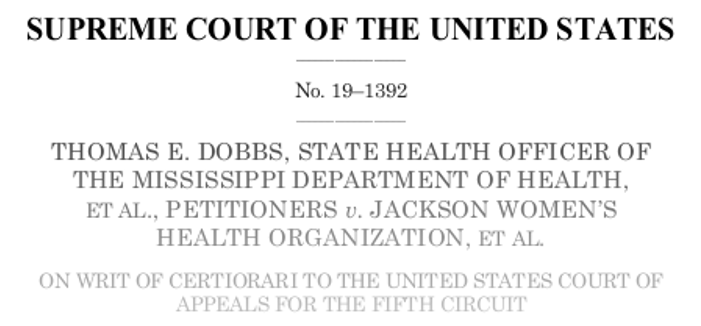
As always, you can find the Dobbs v. Jackson decision here.
Paragraph 5 of 5
Sentence 2 of 3
This sentence contains at least four claims:
“As Justice White later explained, ‘decisions that find in the Constitution principles or values that cannot fairly be read into that document usurp the people’s authority, for such decisions represent choices that the people have never made and that they cannot disavow through corrective legislation.’”
The claims:
- “As Justice White later explained, ‘decisions that find in the Constitution principles or values that cannot fairly be read into that document usurp the people’s authority, for such decisions represent choices that the people have never made and that they cannot disavow through corrective legislation.’”
- “Justice White [wrote that] ‘decisions that find in the Constitution principles or values that cannot fairly be read into that document usurp the people’s authority, for such decisions represent choices that the people have never made and that they cannot disavow through corrective legislation.’”
- “'[D]ecisions that find in the Constitution principles or values that cannot fairly be read into that document usurp the people’s authority.’”
- “'[S]uch decisions represent choices that the people have never made and that they cannot disavow through corrective legislation.’”
The first claim is the entire sentence, and the key words are “as” and “explained,” and the truth of that claim depends on the truth value of the third and fourth claims in this sentence.
The second claim seems to be pretty easy to check on. Here’s the passage in question from Justice White’s dissent (joined by Justice Rehnquist) on page 787 of the Thornquist decision:
“Because the Constitution itself is ordained and established by the people of the United States, constitutional adjudication by this Court does not, in theory at any rate, frustrate the authority of the people to govern themselves through institutions of their own devising and in accordance with principles of their own choosing. But decisions that find in the Constitution principles or values that cannot fairly be read into that document usurp the people’s authority, for such decisions represent choices that the people have never made, and that they cannot disavow through corrective legislation. For this reason, it is essential that this Court maintain the power to restore authority to its proper possessors by correcting constitutional decisions that, on reconsideration, are found to be mistaken.
There it is. Justice White wrote that, so the second claim is true. The third claim is said by Justice White to be true because of the fourth claim, so let’s look at that one next.
- “'[S]uch decisions represent choices that the people have never made and that they cannot disavow through corrective legislation.’”
The first part of this seems true on its face; if the Court makes the decision, then the people have not made the decision. Is it true, though, that no legislation can be passed to countermand the Court’s decision? I know that for fifty years after Roe no legislation countered the Court’s decision, but is it the case that no legislation could counter it? I’ll have to look into that.
That makes the fourth claim undetermined, which renders the third claim undetermined, which leaves the first claim undetermined. So in this quick analysis there is one true claim:
- “Justice White [wrote that] ‘decisions that find in the Constitution principles or values that cannot fairly be read into that document usurp the people’s authority, for such decisions represent choices that the people have never made and that they cannot disavow through corrective legislation.’”
and three undetermined claims:
- “As Justice White later explained, ‘decisions that find in the Constitution principles or values that cannot fairly be read into that document usurp the people’s authority, for such decisions represent choices that the people have never made and that they cannot disavow through corrective legislation.’”
- “'[D]ecisions that find in the Constitution principles or values that cannot fairly be read into that document usurp the people’s authority.’”
- “'[S]uch decisions represent choices that the people have never made and that they cannot disavow through corrective legislation.’”
 Cynical Jason