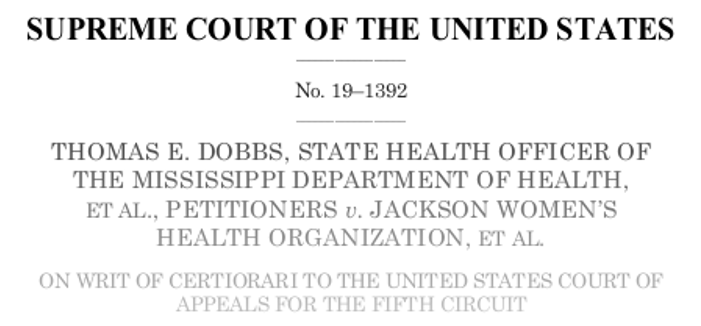
As always, you can find the Dobbs v. Jackson decision here.
Paragraph 6 of 8
Sentence 1 of 2
I get two claims from this sentence:
“On many other occasions, this Court has overruled important constitutional decisions. (We include a partial list in the footnote that follows.48)”
The claims:
- “[T]his Court has overruled important constitutional decisions.”
- “On many other occasions, this Court has overruled important constitutional decisions.”
This first of these is clearly true, and we don’t have to look any further than the last few sentences I’ve posted about. The second claim is kind of subjective (how many is “many”?) and footnote 48 only has a “partial list.”
Just for the sake of thoroughness, here’s footnote 48:
See, e.g., Obergefell v. Hodges, 576 U.S. 644 (2015) (right to same-sex marriage), overruling Baker v. Nelson, 409 U.S. 810 (1972); Citizens United v. Federal Election Comm’n, 558 U.S. 310 (2010) (right to engage in campaign-related speech), overruling Austin v. Michigan Chamber of Commerce, 494 U.S. 652 (1990), and partially overruling McConnell v. Federal Election Comm’n, 540 U.S. 93 (2003); Montejo v. Louisiana, 556 U.S. 778 (2009) (Sixth Amendment right to counsel), overruling Michigan v. Jackson, 475 U.S. 625 (1986); Crawford v. Washington, 541 U.S. 36 (2004) (Sixth Amendment right to confront witnesses), overruling Ohio v. Roberts, 448 U.S. 56 (1980); Lawrence v. Texas, 539 U.S. 558 (2003) (right to engage in consensual, same-sex intimacy in one’s home), overruling Bowers v. Hardwick, 478 U.S. 186 (1986); Ring v. Arizona, 536 U.S. 584 (2002) (Sixth Amendment right to a jury trial in capital prosecutions), overruling Walton v. Arizona, 497 U.S. 639 (1990); Agostini v. Felton, 521 U.S. 203 (1997) (evaluating whether government aid violates the Establishment Clause), overruling Aguilar v. Felton, 473 U.S. 402 (1985), and School Dist. of Grand Rapids v. Ball, 473 U.S. 373 (1985); Seminole Tribe of Fla. v. Florida, 517 U.S. 44 (1996) (lack of congressional power under the Indian Commerce Clause to abrogate States’ Eleventh Amendment immunity), overruling Pennsylvania v. Union Gas Co., 491 U.S. 1 (1989); Payne v. Tennessee, 501 U.S. 808 (1991) (the Eighth Amendment does not erect a per se bar to the admission of victim impact evidence during the penalty phase of a capital trial), overruling Booth v. Maryland, 482 U.S. 496 (1987), and South Carolina v. Gathers, 490 U.S. 805 (1989); Batson v. Kentucky, 476 U.S. 79 (1986) (the Equal Protection Clause guarantees the defendant that the State will not exclude members of his race from the jury venire on account of race), overruling Swain v. Alabama, 380 U.S. 202 (1965); Garcia v. San Antonio Metropolitan Transit Authority, 469 U.S. 528, 530 (1985) (rejecting the principle that the Commerce Clause does not empower Congress to enforce requirements, such as minimum wage laws, against the States “‘in areas of traditional governmental functions’”), overruling National League of Cities v. Usery, 426 U.S. 833 (1976); Illinois v. Gates, 462 U.S. 213 (1983) (the Fourth Amendment requires a totality of the circumstances approach for determining whether an informant’s tip establishes probable cause), overruling Aguilar v. Texas, 378 U.S. 108 (1964), and Spinelli v. United States, 393 U. S. 410 (1969); United States v. Scott, 437 U.S. 82 (1978) (the Double Jeopardy Clause does not apply to Government appeals from orders granting defense motions to terminate a trial before verdict), overruling United States v. Jenkins, 420 U.S. 358 (1975); Craig v. Boren, 429 U.S. 190 (1976) (gender-based classifications are subject to intermediate scrutiny under the Equal Protection Clause), overruling Goesaert v. Cleary, 335 U.S. 464 (1948); Taylor v. Louisiana, 419 U.S. 522 (1975) (jury system which operates to exclude women from jury service violates the defendant’s Sixth and Fourteenth Amendment right to an impartial jury), overruling Hoyt v. Florida, 368 U.S. 57 (1961); Brandenburg v. Ohio, 395 U.S. 444 (1969) (per curiam) (the mere advocacy of violence is protected under the First Amendment unless it is directed to incite or produce imminent lawless action), overruling Whitney v. California, 274 U.S. 357 (1927); Katz v. United States, 389 U.S. 347, 351 (1967) (Fourth Amendment “protects people, not places,” and extends to what a person “seeks to preserve as private”), overruling Olmstead v. United States, 277 U.S. 438 (1928), and Goldman v. United States, 316 U.S. 129 (1942); Miranda v. Arizona, 384 U.S. 436 (1966) (procedural safeguards to protect the Fifth Amendment privilege against self-incrimination), overruling Crooker v. California, 357 U.S. 433 (1958), and Cicenia v. Lagay, 357 U. S. 504 (1958); Malloy v. Hogan, 378 U.S. 1 (1964) (the Fifth Amendment privilege against self-incrimination is also protected by the Fourteenth Amendment against abridgment by the States), overruling Twining v. New Jersey, 211 U. S. 78 (1908), and Adamson v. California, 332 U.S. 46 (1947); Wesberry v. Sanders, 376 U.S. 1, 7–8 (1964) (congressional districts should be apportioned so that “as nearly as is practicable one man’s vote in a congressional election is to be worth as much as another’s”), overruling in effect Colegrove v. Green, 328 U.S. 549 (1946); Gideon v. Wainwright, 372 U.S. 335 (1963) (right to counsel for indigent defendant in a criminal prosecution in state court under the Sixth and Fourteenth Amendments), overruling Betts v. Brady, 316 U.S. 455 (1942); Baker v. Carr, 369 U.S. 186 (1962) (federal courts have jurisdiction to consider constitutional challenges to state redistricting plans), effectively overruling in part Colegrove, 328 U.S. 549; Mapp v. Ohio, 367 U.S. 643 (1961) (the exclusionary rule regarding the inadmissibility of evidence obtained in violation of the Fourth Amendment applies to the States), overruling Wolf v. Colorado, 338 U.S. 25 (1949); Smith v. Allwright, 321 U.S. 649 (1944) (racial restrictions on the right to vote in primary elections violates the Equal Protection Clause of the Fourteenth Amendment), overruling Grovey v. Townsend, 295 U.S. 45 (1935); United States v. Darby, 312 U.S. 100 (1941) (congressional power to regulate employment conditions under the Commerce Clause), overruling Hammer v. Dagenhart, 247 U.S. 251 (1918); Erie R. Co. v. Tompkins, 304 U.S. 64 (1938) (Congress does not have the power to declare substantive rules of common law; a federal court sitting in diversity jurisdiction must apply the substantive state law), overruling Swift v. Tyson, 16 Pet. 1 (1842).
Uh . . . wow. That’s quite a “partial list.” For further fun, here are the cases in list form:
- Obergefell v. Hodges, 576 U.S. 644 (2015) (right to same-sex marriage), overruling Baker v. Nelson, 409 U.S. 810 (1972);
- Citizens United v. Federal Election Comm’n, 558 U.S. 310 (2010) (right to engage in campaign-related speech), overruling Austin v. Michigan Chamber of Commerce, 494 U.S. 652 (1990), and partially overruling McConnell v. Federal Election Comm’n, 540 U.S. 93 (2003);
- Montejo v. Louisiana, 556 U.S. 778 (2009) (Sixth Amendment right to counsel), overruling Michigan v. Jackson, 475 U.S. 625 (1986);
- Crawford v. Washington, 541 U.S. 36 (2004) (Sixth Amendment right to confront witnesses), overruling Ohio v. Roberts, 448 U.S. 56 (1980);
- Lawrence v. Texas, 539 U.S. 558 (2003) (right to engage in consensual, same-sex intimacy in one’s home), overruling Bowers v. Hardwick, 478 U.S. 186 (1986);
- Ring v. Arizona, 536 U.S. 584 (2002) (Sixth Amendment right to a jury trial in capital prosecutions), overruling Walton v. Arizona, 497 U.S. 639 (1990);
- Agostini v. Felton, 521 U.S. 203 (1997) (evaluating whether government aid violates the Establishment Clause), overruling Aguilar v. Felton, 473 U.S. 402 (1985), and School Dist. of Grand Rapids v. Ball, 473 U.S. 373 (1985);
- Seminole Tribe of Fla. v. Florida, 517 U.S. 44 (1996) (lack of congressional power under the Indian Commerce Clause to abrogate States’ Eleventh Amendment immunity), overruling Pennsylvania v. Union Gas Co., 491 U.S. 1 (1989);
- Payne v. Tennessee, 501 U.S. 808 (1991) (the Eighth Amendment does not erect a per se bar to the admission of victim impact evidence during the penalty phase of a capital trial), overruling Booth v. Maryland, 482 U.S. 496 (1987), and South Carolina v. Gathers, 490 U.S. 805 (1989);
- Batson v. Kentucky, 476 U.S. 79 (1986) (the Equal Protection Clause guarantees the defendant that the State will not exclude members of his race from the jury venire on account of race), overruling Swain v. Alabama, 380 U.S. 202 (1965);
- Garcia v. San Antonio Metropolitan Transit Authority, 469 U.S. 528, 530 (1985) (rejecting the principle that the Commerce Clause does not empower Congress to enforce requirements, such as minimum wage laws, against the States “‘in areas of traditional governmental functions’”), overruling National League of Cities v. Usery, 426 U.S. 833 (1976);
- Illinois v. Gates, 462 U.S. 213 (1983) (the Fourth Amendment requires a totality of the circumstances approach for determining whether an informant’s tip establishes probable cause), overruling Aguilar v. Texas, 378 U.S. 108 (1964), and Spinelli v. United States, 393 U. S. 410 (1969);
- United States v. Scott, 437 U.S. 82 (1978) (the Double Jeopardy Clause does not apply to Government appeals from orders granting defense motions to terminate a trial before verdict), overruling United States v. Jenkins, 420 U.S. 358 (1975);
- Craig v. Boren, 429 U.S. 190 (1976) (gender-based classifications are subject to intermediate scrutiny under the Equal Protection Clause), overruling Goesaert v. Cleary, 335 U.S. 464 (1948);
- Taylor v. Louisiana, 419 U.S. 522 (1975) (jury system which operates to exclude women from jury service violates the defendant’s Sixth and Fourteenth Amendment right to an impartial jury), overruling Hoyt v. Florida, 368 U.S. 57 (1961);
- Brandenburg v. Ohio, 395 U.S. 444 (1969) (per curiam) (the mere advocacy of violence is protected under the First Amendment unless it is directed to incite or produce imminent lawless action), overruling Whitney v. California, 274 U.S. 357 (1927);
- Katz v. United States, 389 U.S. 347, 351 (1967) (Fourth Amendment “protects people, not places,” and extends to what a person “seeks to preserve as private”), overruling Olmstead v. United States, 277 U.S. 438 (1928), and Goldman v. United States, 316 U.S. 129 (1942);
- Miranda v. Arizona, 384 U.S. 436 (1966) (procedural safeguards to protect the Fifth Amendment privilege against self-incrimination), overruling Crooker v. California, 357 U.S. 433 (1958), and Cicenia v. Lagay, 357 U. S. 504 (1958);
- Malloy v. Hogan, 378 U.S. 1 (1964) (the Fifth Amendment privilege against self-incrimination is also protected by the Fourteenth Amendment against abridgment by the States), overruling Twining v. New Jersey, 211 U. S. 78 (1908), and Adamson v. California, 332 U.S. 46 (1947);
- Wesberry v. Sanders, 376 U.S. 1, 7–8 (1964) (congressional districts should be apportioned so that “as nearly as is practicable one man’s vote in a congressional election is to be worth as much as another’s”), overruling in effect Colegrove v. Green, 328 U.S. 549 (1946);
- Gideon v. Wainwright, 372 U.S. 335 (1963) (right to counsel for indigent defendant in a criminal prosecution in state court under the Sixth and Fourteenth Amendments), overruling Betts v. Brady, 316 U.S. 455 (1942);
- Baker v. Carr, 369 U.S. 186 (1962) (federal courts have jurisdiction to consider constitutional challenges to state redistricting plans), effectively overruling in part Colegrove, 328 U.S. 549;
- Mapp v. Ohio, 367 U.S. 643 (1961) (the exclusionary rule regarding the inadmissibility of evidence obtained in violation of the Fourth Amendment applies to the States), overruling Wolf v. Colorado, 338 U.S. 25 (1949);
- Smith v. Allwright, 321 U.S. 649 (1944) (racial restrictions on the right to vote in primary elections violates the Equal Protection Clause of the Fourteenth Amendment), overruling Grovey v. Townsend, 295 U.S. 45 (1935);
- United States v. Darby, 312 U.S. 100 (1941) (congressional power to regulate employment conditions under the Commerce Clause), overruling Hammer v. Dagenhart, 247 U.S. 251 (1918);
- Erie R. Co. v. Tompkins, 304 U.S. 64 (1938) (Congress does not have the power to declare substantive rules of common law; a federal court sitting in diversity jurisdiction must apply the substantive state law), overruling Swift v. Tyson, 16 Pet. 1 (1842).
Twenty-six cases (in this “partial list”) that overruled precedent. That’s concrete. A more complete list would presumably include at least twenty-seven. The subjective parts of the sentence keep me from making a determination here. Is twenty-six “many”? Dobbs calls these “important constitutional decisions. Are they all important? The thirteenth decision on this list, United States v. Scott, purports to have determined that “ the Double Jeopardy Clause does not apply to Government appeals from orders granting defense motions to terminate a trial before verdict.” Cool. Is that important? Is it important in the way that Roe was important? I don’t mean these questions to be flippant—they just require more than a passing glance.
Because of that, I’m leaving these two claims undetermined:
- “[T]his Court has overruled important constitutional decisions.”
- “On many other occasions, this Court has overruled important constitutional decisions.”
 Cynical Jason