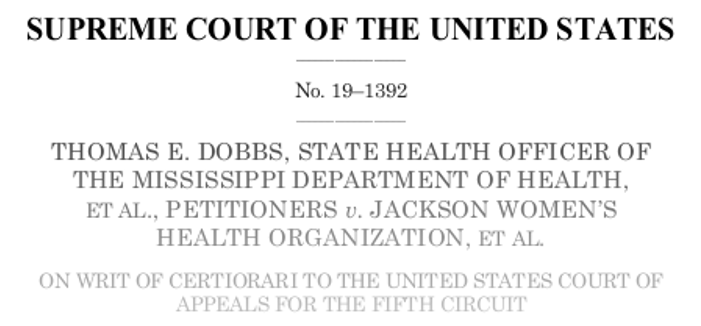
As always, you can find the Dobbs v. Jackson decision here.
One element of the history and tradition that I’d like to examine more closely is the state and territorial laws listed in Appendices A and B of the Dobbs decision, presumably in order of their passing into law. One reason I want to look into this is the assertion that the Dobbs majority makes about the proper authority for making decisions about abortion:
“It is time to heed the Constitution and return the issue of abortion to the people’s elected representatives. ‘The permissibility of abortion, and the limitations, upon it, are to be resolved like most important questions in our democracy: by citizens trying to persuade one another and then voting.’ Casey, 505 U.S., at 979 (Scalia, J., concurring in judgment in part and dissenting in part). That is what the Constitution and the rule of law demand.
The word “return” catches my eye, but so does the phrase “the people’s elected representatives.” Who were these people? How did they arrive at the positions of power that allowed them to make these determinations? What were these elections like? Were the potential laws generally known to the voters when these officials were elected? Lots of questions.
I’ll begin with Missouri, since it’s the first state listed in Appendix A. Here’s what Dobbs has to say about Missouri’s earliest abortion prohibitions:
“Sec. 12. ’That every person who shall wilfully and maliciously administer or cause to be administered to or taken by any person, any poison, or other noxious, poisonous or destructive substance or liquid, with an intention to harm him or her thereby to murder, or thereby to cause or procure the miscarriage of any woman then being with child, and shall thereof be duly convicted, shall suffer imprisonment not exceeding seven years, and be fined not exceeding three thousand dollars.’69”
End note 69:
“1825 Mo. Laws p. 283 (emphasis added); see also, Mo. Rev. Stat., Art. II, §§10, 36 (1835) (extending liability to abortions performed by instrument and establishing differential penalties for pre- and post-quickening abortion) (emphasis added).“
Unfortunately, I’m having a hard time finding information about those laws, so I’m left with all of the questions above.
- What is the timeline?
- How long did the Missouri legislature consider the bill before passing it into law?
- How much public input was there during this process?
- Was there an election during this time?
- Did any of the legislators run for office on this issue?
- Who presented the bill?
- And most importantly: what reasons were given for the bill’s passage?
It looks like Missouri had two governors in 1825, Frederick Bates and Abraham J. Williams. Those two might be worth looking into—or they might have had nothing to do with this. Who knows?
One interesting idea I’ve come across in my haphazard search for information about these laws is that the 1825 law seemed to be less about abortion specifically and more about ending an epidemic of deaths by poison. Apparently too many pregnant women were dying due to toxic abortifacients and the Missouri legislature decided something must be done about it.
This article at the Kansas City Star tells the story in more detail:
“Scholars have called these early laws ‘poison control.’ The Missouri and Connecticut laws of this period didn’t explicitly ban abortion itself, but rather banned abortions using poison.
“’That really was because there were a lot of women dying and there were a lot of women dying because the things– the concoctions, ectcetera [sic]– they’re taking are deadly,’ said Evan Hart, an assistant professor of history at Missouri Western State University who studies Missouri abortion laws and the courts in the late 19th and early 20th centuries.
I should check into Evan Hart’s work, too.
 Cynical Jason