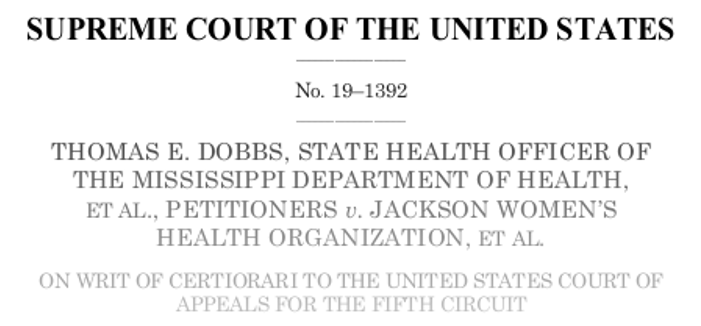
As always, you can find the Dobbs v. Jackson decision here.
Paragraph 2 of 8
Sentence 1 of 6
This sentence has three claims:
“We have long recognized, however, that stare decisis is ‘not an inexorable command,’ Pearson v. Callahan, 555 U. S. 223, 233 (2009) (internal quotation marks omitted), and it ‘is at its weakest when we interpret the Constitution,’ Agostini v. Felton, 521 U.S. 203, 235 (1997).”
The claims:
- “[S]tare decisis is ‘not an inexorable command.’”
- “We have long recognized [. . .] that stare decisis is ‘not an inexorable command.’”
- “[Stare decisis] ‘is at its weakest when we interpret the Constitution.’”
The first two claims are attached to a citation for Pearson, so here’s that material:
“In considering whether the Saucier procedure should be modified or abandoned, we must begin with the doctrine of stare decisis. Stare decisis ‘promotes the evenhanded, predictable, and consistent development of legal principles, fosters reliance on judicial decisions, and contributes to the actual and perceived integrity of the judicial process.’ Payne v. Tennessee, 501 U. S. 808, 827 (1991) . Although ‘[w]e approach the reconsideration of [our] decisions … with the utmost caution,’ ‘[s]tare decisis is not an inexorable command.’ State Oil Co. v. Khan, 522 U. S. 3, 20 (1997) (internal quotation marks omitted).”
They keep rolling out the same sentence in support of the idea (or to reiterate the idea), and I have no trouble believing that it’s true, but I’ll need an argument. I’ll keep them undetermined until I can look into it more.
The third claim cites Agostini, so here’s that:
“The doctrine of stare decisis does not preclude us from recognizing the change in our law and overruling Aguilar and those portions of Ball inconsistent with our more recent decisions. As we have often noted, ‘[s]tare decisis is not an inexorable command,’ Payne v. Tennessee, 501 U. S. 808, 828 (1991), but instead reflects a policy judgment that ‘in most matters it is more important that the applicable rule of law be settled than that it be settled right,’ Burnet v. Coronado Oil & Gas Co., 285 U. S. 393, 406 (1932) (Brandeis, J., dissenting). That policy is at its weakest when we interpret the Constitution because our interpretation can be altered only by constitutional amendment or by overruling our prior decisions. Seminole Tribe of Fla. v. Florida, 517 U. S. 44, 63 (1996); Payne, supra, at 828; St. Joseph Stock Yards Co. v. United States, 298 U. S. 38, 94 (1936) (Stone and Cardozo, JJ., concurring in result) (“The doctrine of stare decisis … has only a limited application in the field of constitutional law”).
And there’s Payne again for good measure. I’ll have to dig into the Seminole Tribe case to see if there’s anything more than an assertion for this idea. That makes three undetermined claims in this sentence:
- “[S]tare decisis is ‘not an inexorable command.’”
- “We have long recognized [. . .] that stare decisis is ‘not an inexorable command.’”
- “[Stare decisis] ‘is at its weakest when we interpret the Constitution.’”
 Cynical Jason