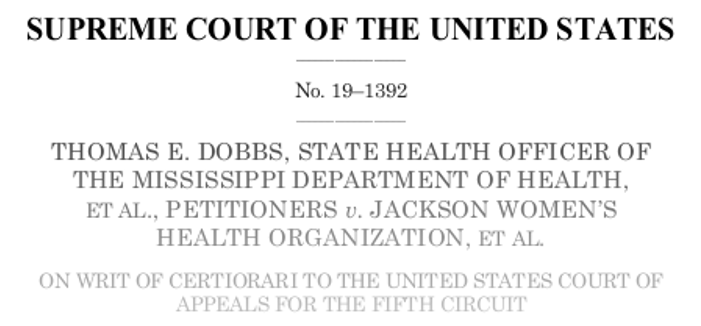
As always, you can find the Dobbs v. Jackson decision here.
Paragraph 3 of 3
Sentence 3 of 4
This sentence is one claim:
“But as the Court has reiterated time and time again, adherence to precedent is not ‘“an inexorable command.”’ Kimble v. Marvel Entertainment, LLC, 576 U.S. 446, 455 (2015).”
I’ll rephrase the claim to make it less awkward standing alone:
- “[T]he Court has reiterated time and time again [that] adherence to precedent is not ‘“an inexorable command.”’
This paragraph appears in Kimble:
“Overruling precedent is never a small matter. Stare decisis—in English, the idea that today’s Court should stand by yesterday’s decisions—is ‘a foundation stone of the rule of law.’ Michigan v. Bay Mills Indian Community, 572 U.S. ___, ___ (2014) (slip op., at 15). Application of that doctrine, although ‘not an inexorable command,’ is the ‘preferred course because it promotes the evenhanded, predictable, and consistent development of legal principles, fosters reliance on judicial decisions, and contributes to the actual and perceived integrity of the judicial process.’ Payne v. Tennessee, 501 U. S. 808 –828 (1991). It also reduces incentives for challenging settled precedents, saving parties and courts the expense of endless relitigation.
Those words appear in Kimble, and if the idea is also expressed in Michigan v. Bay Mills and Payne v. Tennessee, that’s three times in just one paragraph. Does that amount to “time and time again”? I guess if the idea has been iterated, and then it’s reiterated two times and one time comes after the other, that’s “reiterated time and time again.”
Here’s Michigan . . . citing Payne:
“But this Court does not overturn its precedents lightly. Stare decisis, we have stated, ‘is the preferred course because it promotes the evenhanded, predictable, and consistent development of legal principles, fosters reliance on judicial decisions, and contributes to the actual and perceived integrity of the judicial process.’ Payne v. Tennessee, 501 U.S. 808, 827 (1991) . Although ‘not an inexorable command,’ id., at 828, stare decisis is a foundation stone of the rule of law, necessary to ensure that legal rules develop ‘in a principled and intelligible fashion,’ Vasquez v. Hillery, 474 U.S. 254, 265 (1986) .
And here’s Payne:
“Although adherence to the doctrine of stare decisis is usually the best policy, the doctrine is not an inexorable command. This Court has never felt constrained to follow precedent when governing decisions are unworkable or badly reasoned, Smith v. Allwright, 321 U. S. 649, 321 U. S. 655, particularly in constitutional cases, where correction through legislative action is practically impossible, Burnet v. Coronado Oil & Gas Co., 285 U. S. 393, 285 U. S. 407 (Brandeis, J., dissenting), and in cases involving procedural and evidentiary rules.
Seems a little incestuous, but there it is. And Payne even cites two other cases. One of those times is bound to be after another of those times. I’m going to call this claim true:
- “[T]he Court has reiterated time and time again [that] adherence to precedent is not ‘“an inexorable command.”’
 Cynical Jason