As always, you can find the Dobbs v. Jackson decision here.
Paragraph 3 of 3
Sentence 3 of 5
I see three claims in this sentence:
“As explained, for more than a century after 1868—including ‘another half-century’ after women gained the constitutional right to vote in 1920, see post, at 15; Amdt. 19—it was firmly established that laws prohibiting abortion like the Texas law at issue in Roe were permissible exercises of state regulatory authority.”
The claims:
- “[F]or more than a century after 1868 [. . .] t was firmly established that laws prohibiting abortion like the Texas law at issue in Roe were permissible exercises of state regulatory authority.”
- “[F]or [. . .] ‘another half-century’ after women gained the constitutional right to vote in 1920, [. . .] it was firmly established that laws prohibiting abortion like the Texas law at issue in Roe were permissible exercises of state regulatory authority.”
- “[I]t was firmly established that laws prohibiting abortion like the Texas law at issue in Roe were permissible exercises of state regulatory authority.”
I’m confident that these claims have been substantiated in what we’ve already covered, but I’m not going to take the time to round that up right now. They’re true (I suppose I have concerns about the phrase “firmly established,” but that might just be a quibble), but until I directly link the passages to these claims they’ll remain undetermined:
- “[F]or more than a century after 1868 [. . .] t was firmly established that laws prohibiting abortion like the Texas law at issue in Roe were permissible exercises of state regulatory authority.”
- “[F]or [. . .] ‘another half-century’ after women gained the constitutional right to vote in 1920, [. . .] it was firmly established that laws prohibiting abortion like the Texas law at issue in Roe were permissible exercises of state regulatory authority.”
- “[I]t was firmly established that laws prohibiting abortion like the Texas law at issue in Roe were permissible exercises of state regulatory authority.”
For what it’s worth, I think this is what this sentence is pointing to in the dissent at page 15:
“So it is perhaps not so surprising that the ratifiers were not perfectly attuned to the importance of reproductive rights for women’s liberty, or for their capacity to participate as equal members of our Nation. Indeed, the ratifiers—both in 1868 and when the original Constitution was approved in 1788—did not understand women as full members of the community embraced by the phrase ‘We the People.’ In 1868, the first wave of American feminists were explicitly told—of course by men—that it was not their time to seek constitutional protections. (Women would not get even the vote for another half-century.) To be sure, most women in 1868 also had a foreshortened view of their rights: If most men could not then imagine giving women control over their bodies, most women could not imagine having that kind of autonomy. But that takes away nothing from the core point. Those responsible for the original Constitution, including the Fourteenth Amendment, did not perceive women as equals, and did not recognize women’s rights. When the majority says that we must read our foundational charter as viewed at the time of ratification (except that we may also check it against the Dark Ages), it consigns women to second-class citizenship.
And, just for fun, here’s an image of the nineteenth amendment from the National Archives:
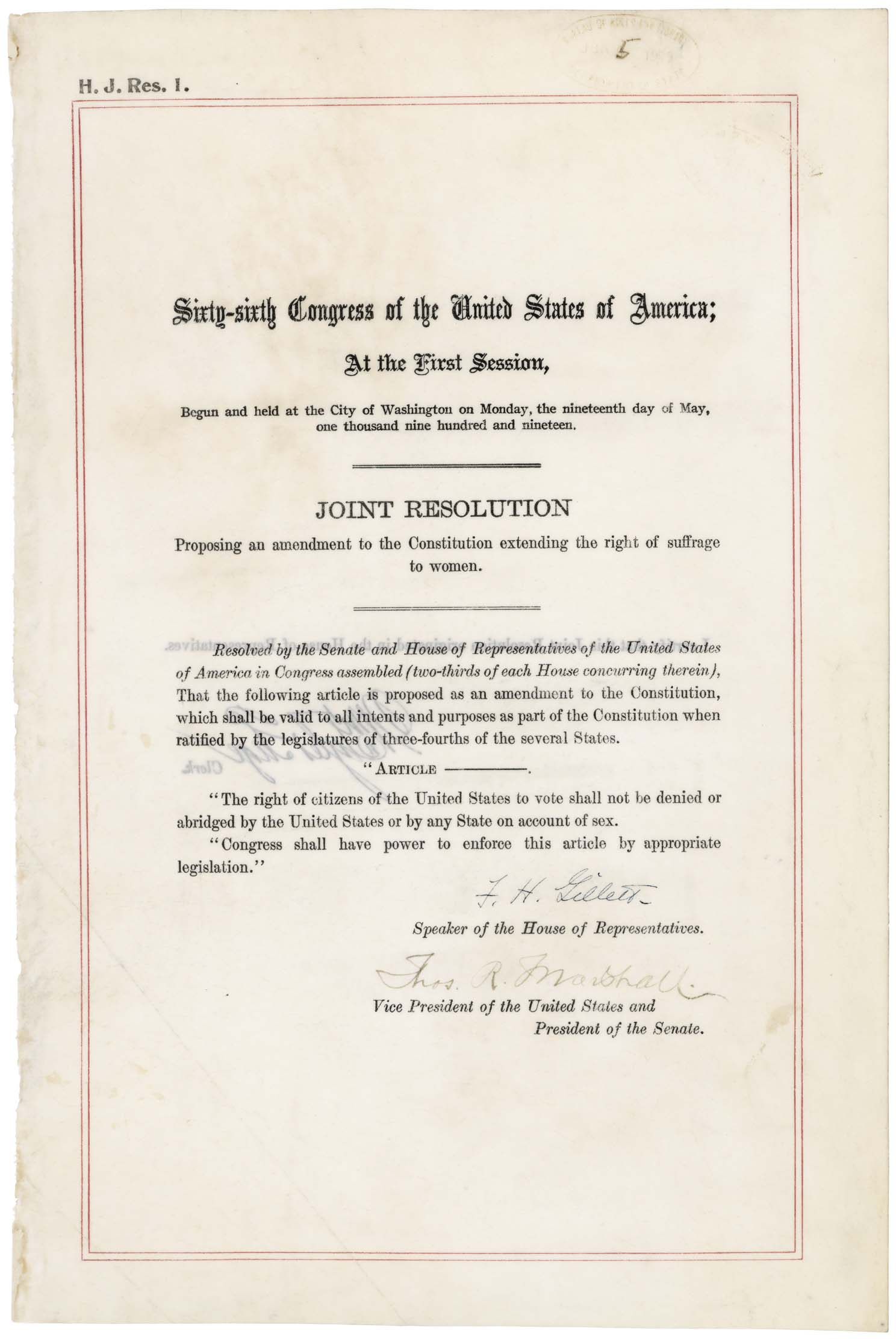
And here’s the relevant text:
“The right of citizens of the United States to vote shall not be denied or abridged by the United States or by any State on account of sex.”
This doesn’t really do anything for the argument—it’s just acknowledging common knowledge—but it’s worth having on hand.
 Cynical Jason