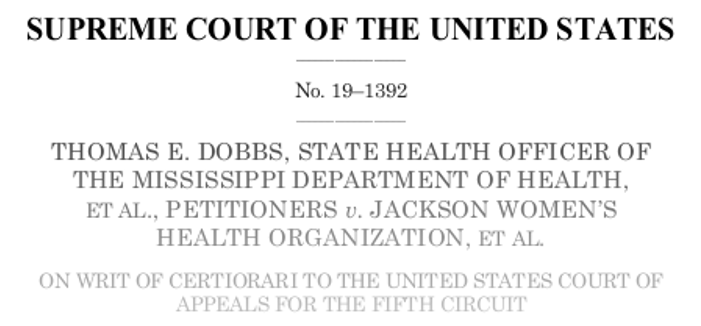
As always, you can find the Dobbs v. Jackson decision here.
Paragraph 1 of 3
Sentence 3 of 3
This sentence packs in a lot of low-impact claims:
“Nor does the dissent dispute the fact that abortion was illegal at common law at least after quickening; that the 19th century saw a trend toward criminalization of pre-quickening abortions; that by 1868, a supermajority of States (at least 26 of 37) had enacted statutes criminalizing abortion at all stages of pregnancy; that by the late 1950s at least 46 States prohibited abortion ‘however and whenever performed’ except if necessary to save ‘the life of the mother,’ Roe, 410 U.S., at 139; and that when Roe was decided in 1973 similar statutes were still in effect in 30 States. Compare post, at 12–14, nn. 2–3, with supra, at 23–25, and nn. 33–34.47
The claims:
- “[T]he dissent [does not] dispute the fact that abortion was illegal at common law at least after quickening.”
- “[The dissent does not dispute the fact] that the 19th century saw a trend toward criminalization of pre-quickening abortions;
- “[The dissent does not dispute the fact] that by 1868, a supermajority of States (at least 26 of 37) had enacted statutes criminalizing abortion at all stages of pregnancy;
- “[The dissent does not dispute the fact] that by the late 1950s at least 46 States prohibited abortion ‘however and whenever performed’ except if necessary to save ‘the life of the mother,’ Roe, 410 U.S., at 139; and
- “[The dissent does not dispute the fact] that when Roe was decided in 1973 similar statutes were still in effect in 30 States. Compare post, at 12–14, nn. 2–3, with supra, at 23–25, and nn. 33–34.47
Again, the Dobbs Court is belaboring the dissent’s decision to not engage with history and tradition as the determining factor in the case. More importantly to my focus at the moment: it’s another case of Dobbs pointing out what the dissent doesn’t do (and doesn’t try to). Short of scanning the whole dissent for the sake of this sentence, there’s no way to verify or dispute this, so these claims remain undetermined for now:
- “[T]he dissent [does not] dispute the fact that abortion was illegal at common law at least after quickening.”
- “[The dissent does not dispute the fact] that the 19th century saw a trend toward criminalization of pre-quickening abortions;
- “[The dissent does not dispute the fact] that by 1868, a supermajority of States (at least 26 of 37) had enacted statutes criminalizing abortion at all stages of pregnancy;
- “[The dissent does not dispute the fact] that by the late 1950s at least 46 States prohibited abortion ‘however and whenever performed’ except if necessary to save ‘the life of the mother,’ Roe, 410 U.S., at 139; and
- “[The dissent does not dispute the fact] that when Roe was decided in 1973 similar statutes were still in effect in 30 States. Compare post, at 12–14, nn. 2–3, with supra, at 23–25, and nn. 33–34.47
 Cynical Jason