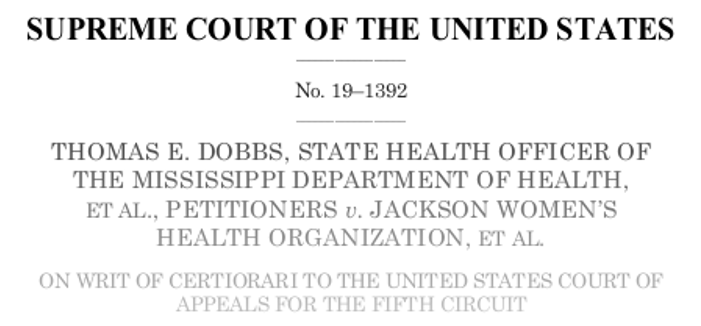
As always, you can find the Dobbs v. Jackson decision here.
Paragraph 6 of 6
Sentence 1 of 4
This sentence is packed with significance—and three claims:
“What sharply distinguishes the abortion right from the rights recognized in the cases on which Roe and Casey rely is something that both those decisions acknowledged: Abortion destroys what those decisions call ‘potential life’ and what the law at issue in this case regards as the life of an ‘unborn human being.’ See Roe, 410 U.S., at 159 (abortion is “inherently different”); Casey, 505 U.S., at 852 (abortion is “a unique act”).”
This sentence is a critical vector. A nexus. An inflection point. Here are the three claims:
- “What sharply distinguishes the abortion right from the rights recognized in the cases on which Roe and Casey rely is something that both those decisions acknowledged: Abortion destroys what those decisions call ‘potential life’ and what the law at issue in this case regards as the life of an ‘unborn human being.’”
- “[B]oth [of] those decisions acknowledged [that a]bortion destroys what those decisions call ‘potential life’ and what the law at issue in this case regards as the life of an ‘unborn human being.’”
- “Abortion destroys what those decisions call ‘potential life’ and what the law at issue in this case regards as the life of an ‘unborn human being.’”
This is a lot, so let’s go slowly. Here’s the first claim:
- “What sharply distinguishes the abortion right from the rights recognized in the cases on which Roe and Casey rely is something that both those decisions acknowledged: Abortion destroys what those decisions call ‘potential life’ and what the law at issue in this case regards as the life of an ‘unborn human being.’”
This claim is true on its face. Whether we call it a “fetus” or an “unborn child” or a “MacGuffin,” abortion involves the destruction of the object in question and none of the other examples do. That is a distinction, though I don’t know about the word “sharply” here.
How about the second claim?
- “[B]oth [of] those decisions acknowledged [that a]bortion destroys what those decisions call ‘potential life’ and what the law at issue in this case regards as the life of an ‘unborn human being.’”
Here’s what Roe has to say (I’ll start on page 158:
“All this, together with our observation, supra, that, throughout the major portion of the 19th century, prevailing legal abortion practices were far freer than they are today, persuades us that the word ‘person,’ as used in the Fourteenth Amendment, does not include the unborn. [Footnote 55] This is in accord with the results reached in those few cases where the issue has been squarely presented. McGarvey v. Magee-Womens Hospital, 340 F. Supp. 751 (WD Pa.1972); Byrn v. New York City Health & Hospitals Corp., 31 N.Y.2d 194, 286 N.E.2d 887 (1972), appeal docketed, No. 72-434; Abele v. Markle, 351 F. Supp. 224 (Conn.1972), appeal docketed, No. 72-730. Cf. Cheaney v. State, ___ Ind. at ___, 285 N.E.2d at 270; Montana v. Rogers, 278 F.2d 68, 72 (CA7 1960), aff’d sub nom. Montana v. Kennedy, 366 U. S. 308 (1961); Keeler v. Superior Court, 2 Cal. 3d 619, 470 P.2d 617 (1970); State v. Dickinson, 28
“Ohio St.2d 65, 275 N.E.2d 599 (1971). Indeed, our decision in United States v. Vuitch, 402 U. S. 62 (1971), inferentially is to the same effect, for we there would not have indulged in statutory interpretation favorable to abortion in specified circumstances if the necessary consequence was the termination of life entitled to Fourteenth Amendment protection.
“This conclusion, however, does not of itself fully answer the contentions raised by Texas, and we pass on to other considerations.
“B. The pregnant woman cannot be isolated in her privacy. She carries an embryo and, later, a fetus, if one accepts the medical definitions of the developing young in the human uterus. See Dorland’s Illustrated Medical Dictionary 478-479, 547 (24th ed.1965). The situation therefore is inherently different from marital intimacy, or bedroom possession of obscene material, or marriage, or procreation, or education, with which Eisenstadt and Griswold, Stanley, Loving, Skinner, and Pierce and Meyer were respectively concerned. As we have intimated above, it is reasonable and appropriate for a State to decide that, at some point in time another interest, that of health of the mother or that of potential human life, becomes significantly involved. The woman’s privacy is no longer sole and any right of privacy she possesses must be measured accordingly.
“Texas urges that, apart from the Fourteenth Amendment, life begins at conception and is present throughout pregnancy, and that, therefore, the State has a compelling interest in protecting that life from and after conception. We need not resolve the difficult question of when life begins. When those trained in the respective disciplines of medicine, philosophy, and theology are unable to arrive at any consensus, the judiciary, at this point in the development of man’s knowledge, is not in a position to speculate as to the answer.
And here’s Casey on page 852:
“These considerations begin our analysis of the woman’s interest in terminating her pregnancy but cannot end it, for this reason: though the abortion decision may originate within the zone of conscience and belief, it is more than a philosophic exercise. Abortion is a unique act. It is an act fraught with consequences for others: for the woman who must live with the implications of her decision; for the persons who perform and assist in the procedure; for the spouse, family, and society which must confront the knowledge that these procedures exist, procedures some deem nothing short of an act of violence against innocent human life; and, depending on one’s beliefs, for the life or potential life that is aborted. Though abortion is conduct, it does not follow that the State is entitled to proscribe it in all instances. That is because the liberty of the woman is at stake in a sense unique to the human condition and so unique to the law. The mother who carries a child to full term is subject to anxieties, to physical constraints, to pain that only she must bear. That these sacrifices have from the beginning of the human race been endured by woman with a pride that ennobles her in the eyes of others and gives to the infant a bond of love cannot alone be grounds for the State to insist she make the sacrifice. Her suffering is too intimate and personal for the State to insist, without more, upon its own vision of the woman’s role, however dominant that vision has been in the course of our history and our culture. The destiny of the woman must be shaped to a large extent on her own conception of her spiritual imperatives and her place in society.
Frankly, it would be weird if either case denied the central idea of the procedure in question, but the Dobbs claim is true, as far as it goes.
The third claim closely follows the second:
- “Abortion destroys what those decisions call ‘potential life’ and what the law at issue in this case regards as the life of an ‘unborn human being.’”
Those are the labels used in Roe and Casey, as well as in and the object that is labeled as such is “destroyed” in an abortion. This is true.
So we have three true claims:
- “What sharply distinguishes the abortion right from the rights recognized in the cases on which Roe and Casey rely is something that both those decisions acknowledged: Abortion destroys what those decisions call ‘potential life’ and what the law at issue in this case regards as the life of an ‘unborn human being.’”
- “[B]oth [of] those decisions acknowledged [that a]bortion destroys what those decisions call ‘potential life’ and what the law at issue in this case regards as the life of an ‘unborn human being.’”
- “Abortion destroys what those decisions call ‘potential life’ and what the law at issue in this case regards as the life of an ‘unborn human being.’”
One final point on this sentence. As I’ve mentioned previously, the Dobbs majority has gone to great lengths to distance itself from determining the status of the fetus/unborn child/MacGuffin, but in this sentence—which makes a crucial point in the Dobbs argument—the status of the fetus is the sole determining factor separating supportable claims from an unsupportable one.
Curious.
 Cynical Jason