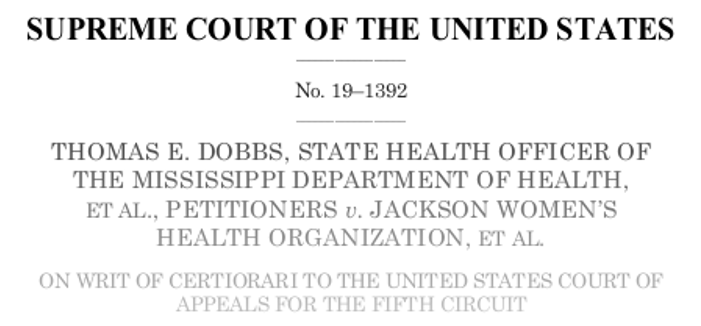
As always, you can find the Dobbs v. Jackson decision here.
Paragraph 5 of 6
Sentence 2 of 3
The second sentence in this paragraph is a cornucopia of citations:
“Casey relied on cases involving the right to marry a person of a different race, Loving v. Virginia, 388 U.S. 1 (1967); the right to marry while in prison, Turner v. Safley, 482 U.S. 78 (1987); the right to obtain contraceptives, Griswold v. Connecticut, 381 U.S. 479 (1965), Eisenstadt v. Baird, 405 U.S. 438 (1972), Carey v. Population Services Int’l, 431 U.S. 678 (1977); the right to reside with relatives, Moore v. East Cleveland, 431 U.S. 494 (1977); the right to make decisions about the education of one’s children, Pierce v. Society of Sisters, 268 U.S. 510 (1925), Meyer v. Nebraska, 262 U.S. 390 (1923); the right not to be sterilized without consent, Skinner v. Oklahoma ex rel. Williamson, 316 U. S. 535 (1942); and the right in certain circumstances not to undergo involuntary surgery, forced administration of drugs, or other substantially similar procedures, Winston v. Lee, 470 U.S. 753 (1985), Washington v. Harper, 494 U.S. 210 (1990), Rochin v. California, 342 U.S. 165 (1952).
Holy crap. Let’s look at that with the citations stripped out:
“Casey relied on cases involving the right to marry a person of a different race, the right to marry while in prison, the right to obtain contraceptives, the right to reside with relatives, the right to make decisions about the education of one’s children, the right not to be sterilized without consent, and the right in certain circumstances not to undergo involuntary surgery, forced administration of drugs, or other substantially similar procedures.
That’s a lot of elements for just one claim. Certainly too much to check on in a first pass, and might not even be worth bothering with at all, depending on what this leads to. We’ll see.
This is undetermined:
- “Casey relied on cases involving the right to marry a person of a different race, the right to marry while in prison, the right to obtain contraceptives, the right to reside with relatives, the right to make decisions about the education of one’s children, the right not to be sterilized without consent, and the right in certain circumstances not to undergo involuntary surgery, forced administration of drugs, or other substantially similar procedures.
For the sake of future possible research—here’s what to follow up on:
- the right to marry a person of a different race, Loving v. Virginia, 388 U.S. 1 (1967)
- the right to marry while in prison, Turner v. Safley, 482 U.S. 78 (1987)
- the right to obtain contraceptives, Griswold v. Connecticut, 381 U.S. 479 (1965), Eisenstadt v. Baird, 405 U.S. 438 (1972), Carey v. Population Services Int’l, 431 U.S. 678 (1977)
- the right to reside with relatives, Moore v. East Cleveland, 431 U.S. 494 (1977)
- the right to make decisions about the education of one’s children, Pierce v. Society of Sisters, 268 U.S. 510 (1925), Meyer v. Nebraska, 262 U.S. 390 (1923)
- the right not to be sterilized without consent, Skinner v. Oklahoma ex rel. Williamson, 316 U. S. 535 (1942)
- and the right in certain circumstances not to undergo involuntary surgery, forced administration of drugs, or other substantially similar procedures, Winston v. Lee, 470 U.S. 753 (1985), Washington v. Harper, 494 U.S. 210 (1990), Rochin v. California, 342 U.S. 165 (1952).
 Cynical Jason