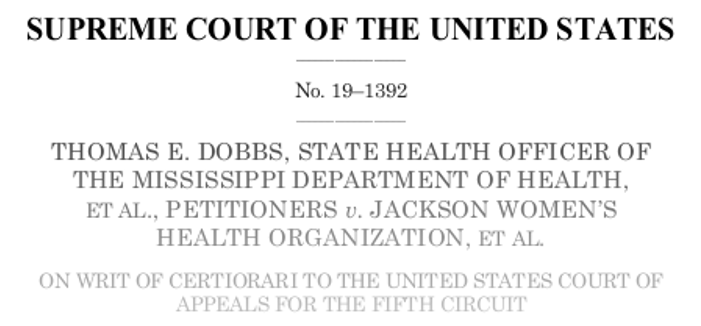
As always, you can find the Dobbs v. Jackson decision here.
Paragraph 3 of 6
Sentence 1 of 3
The next paragraph starts with a sentence containing two claims:
“The Court did not claim that this broadly framed right is absolute, and no such claim would be plausible.”
The claims:
- “The Court did not claim that this broadly framed right is absolute.”
- “[N]o [. . .] claim [that this broadly framed right is absolute] would be plausible.”
As for the first claim: not only did the Roe and Casey Courts not claim that “not claim that this broadly framed right is absolute.” They both went out of their way to declare that the right was not absolute.
Roe repeats this assertion a number of times, such as on page 153:
“On the basis of elements such as these, appellant and some amici argue that the woman’s right is absolute and that she is entitled to terminate her pregnancy at whatever time, in whatever way, and for whatever reason she alone chooses. With this we do not agree.”
And again on page 154:
“As noted above, a State may properly assert important interests in safeguarding health, in maintaining medical standards, and in protecting potential life. At some point in pregnancy, these respective interests become sufficiently compelling to sustain regulation of the factors that govern the abortion decision. The privacy right involved, therefore, cannot be said to be absolute.”
And again on page 155:
“Although the results are divided, most of these courts have agreed that the right of privacy, however based, is broad enough to cover the abortion decision; that the right, nonetheless, is not absolute, and is subject to some limitations; and that, at some point, the state interests as to protection of health, medical standards, and prenatal life, become dominant. We agree with this approach.”
Also, you can find the Roe v. Wade decision here.
Casey uses Roe’s claims to reiterate the point:
“It is, as a consequence, not surprising that despite the protestations contained in the original Roe opinion to the effect that the Court was not recognizing an absolute right, 410 U.S., at 154-155, 93 S.Ct., at 727, the Court’s experience applying the trimester framework has led to the striking down of some abortion regulations which in no real sense deprived women of the ultimate decision.”
And Casey also refers to the Doe v. Bolton case to reinforce the claim:
“In the companion case of Doe v. Bolton, 410 U.S. 179, 93 S.Ct. 739, 35 L.Ed.2d 201 (1973), the Court referred to its conclusion in Roe “that a pregnant woman does not have an absolute constitutional right to an abortion on her demand.” 410 U.S., at 189, 93 S.Ct., at 746.”
And Casey makes the point on its own in footnote 5:
“To say that restrictions on a right are subject to strict scrutiny is not to say that the right is absolute.”
Here is a link to the Casey decision.
While this claim is true, it feels like a misrepresentation. The Dobbs claim makes Roe and Casey seem merely uncommitted to the “absoluteness” of the rights they argue for while both Courts actively denounced that “absoluteness.” There’s a difference between “not saying” and “saying not.”
I’m not sure why this sentence is here—it’s refuting a past-tense hypothetical that was blocked at its genesis—unless the Dobbs Court is going to claim in the next few sentences that Jackson Women’s Health Organization is making that claim now. I’m interested to see what’s coming.
The second claim is even weirder. Another hypothetical, but one that insists that if the thing that has not been done had been done it would have failed.
This might be a weird paragraph.
The first claim is true:
- “The Court did not claim that this broadly framed right is absolute.”
I’m not sure how the second claim could be supported or refuted, so I’m calling it undetermined:
- “[N]o [. . .] claim [that this broadly framed right is absolute] would be plausible.”
 Cynical Jason