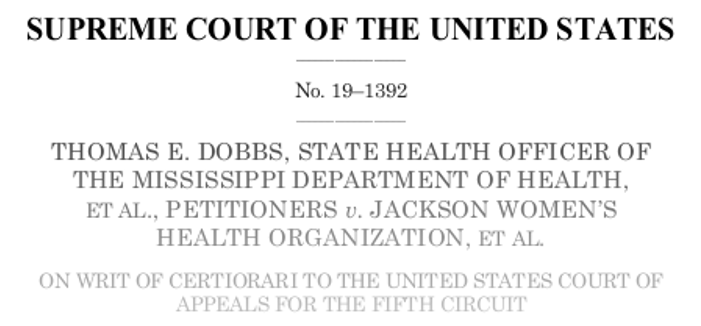
As always, you can find the Dobbs v. Jackson decision here.
Paragraph 6 of 11
Sentence 1 of 4
I see three claims in the next sentence:
“The Solicitor General next suggests that history supports an abortion right because the common law’s failure to criminalize abortion before quickening means that ‘at the Founding and for decades thereafter, women generally could terminate a pregnancy, at least in its early stages.’40 Brief for United States 26–27; see also Brief for Respondents 21.”
The three claims are tied closely together, with the whole sentence being one of them:
- “The Solicitor General next suggests that history supports an abortion right.”
- “[T]he common law’s failure to criminalize abortion before quickening means that ‘at the Founding and for decades thereafter, women generally could terminate a pregnancy, at least in its early stages.’”
- “The Solicitor General next suggests that history supports an abortion right because the common law’s failure to criminalize abortion before quickening means that ‘at the Founding and for decades thereafter, women generally could terminate a pregnancy, at least in its early stages.’”
End note 40:
In any event, Roe, Casey, and other related abortion decisions imposed substantial restrictions on a State’s capacity to regulate abortions performed after quickening. See, e.g., June Medical Services L.L.C. v. Russo, 591 U.S. ___ (2020) (holding a law requiring doctors performing abortions to secure admitting privileges to be unconstitutional); Whole Woman’s Health v. Hellerstedt, 579 U. S. 582 (2016) (similar); Casey, 505 U.S., at 846 (declaring that prohibitions on “abortion before viability” are unconstitutional); id., at 887–898 (holding that a spousal notification provision was unconstitutional). In addition, Doe v. Bolton, 410 U.S. 179 (1973), has been interpreted by some to protect a broad right to obtain an abortion at any stage of pregnancy provided that a physician is willing to certify that it is needed due to a woman’s “emotional” needs or “familial” concerns. Id., at 192. See, e.g., Women’s Medical Professional Corp. v. Voinovich, 130 F. 3d 187, 209 (CA6 1997), cert. denied, 523 U. S. 1036 (1998); but see id., at 1039 (Thomas, J., dissenting from denial of certiorari).
And then we need to check both “Brief for United States 26–27” and “Brief for Respondents 21.” That’s a lot of checking. We’ll save that for later. These are undetermined:
- “The Solicitor General next suggests that history supports an abortion right.”
- “[T]he common law’s failure to criminalize abortion before quickening means that ‘at the Founding and for decades thereafter, women generally could terminate a pregnancy, at least in its early stages.’”
- “The Solicitor General next suggests that history supports an abortion right because the common law’s failure to criminalize abortion before quickening means that ‘at the Founding and for decades thereafter, women generally could terminate a pregnancy, at least in its early stages.’”
 Cynical Jason