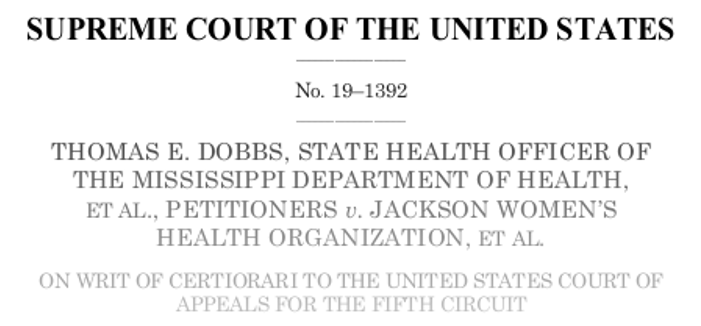
As always, you can find the Dobbs v. Jackson decision here.
Paragraph 2 of 11
Sentence 2 of 3
Another sentence with a single claim:
“Instead, respondents are forced to argue that it ‘does [not] matter that some States prohibited abortion at the time Roe was decided or when the Fourteenth Amendment was adopted.’ Brief for Respondents 21.”
That’s a weird phrase: “respondents are forced to,” Forced to? It seems possible that they would see that as a legitimate argument. I’m not convinced that “history and tradition” commands the regard the Dobbs Court has for it.
More to the point, it seems strange to isolate this quote from its context. Here’s the passage as it appears in the Brief (actually on page 20, which is the 35th page of the PDF):
“Nor does it matter that some states prohibited abortion at the time Roe was decided or when the Fourteenth Amendment was adopted. Petrs. Br. 13. If that were a basis for overruling precedent, then Brown v. Board of Education, 347 U.S. 483 (1954), would have to go, for the same Congress that enacted the Fourteenth Amendment also segregated the D.C. public school system. So would Gideon v. Wainwright, 372 U.S. 335 (1963), and Loving v. Virginia, 388 U.S. 1 (1967). Some believe Heller similarly lacks any historical foundation. See 554 U.S. At 683-87 (Breyer, J, dissenting). The list could go on and on.”
“At any rate, history and tradition provide ample support for the conclusion that ‘liberty’ encompasses an individual’s right to end a pre-viablilty pregnancy. The Court has long recognized that ‘[n]o right is held more sacred, or is more carefully guarded by the common law, than the right of every individual to the possession and control of his own person.’ Union Pacific Ry. Co. v. Botsford, 141 U.S. 250, 251-52 (1891). Further, the common law permitted abortion up to a certain point in pregnancy, and many states maintained that common law tradition as of the late 1850s. See Roe, 410 U.S. At 140 (concluding that, for much of history and particularly during nineteenth century, ‘a woman enjoyed a substantially broader right to terminate a pregnancy than she does in most States today’); see also generally Historians Br.”
So Jackson definitely argues the point Dobbs attributes to it, but is it “forced”? I’ll call this undetermined for now, but “uncharitable” or “misleading” might be better labels:
- “Instead, respondents are forced to argue that it ‘does [not] matter that some States prohibited abortion at the time Roe was decided or when the Fourteenth Amendment was adopted.’”
 Cynical Jason