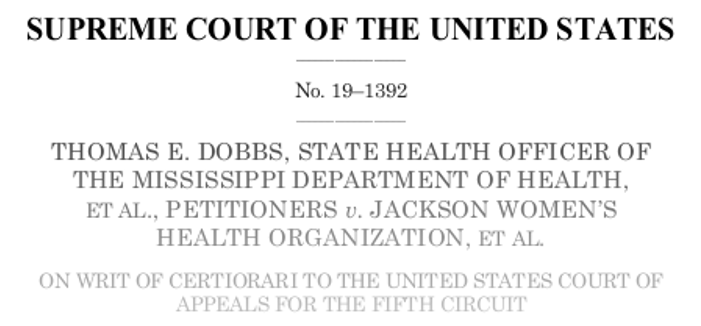
As always, you can find the Dobbs v. Jackson decision here.
Paragraph 1 of 6
Sentence 2 of 2
This sentence is a history lesson in two claims:
“At that time, there were no scientific methods for detecting pregnancy in its early stages,31 and thus, as one court put it in 1872: ‘[U]ntil the period of quickening there is no evidence of life; and whatever may be said of the feotus, the law has fixed upon this period of gestation as the time when the child is endowed with life’ because ‘foetal movements are the first clearly marked and well defined evidences of life.’ Evans v. People, 49 N.Y. 86, 90 (emphasis added); Cooper, 22 N.J.L., at 56 (‘In contemplation of law life commences at the moment of quickening, at that moment when the embryo gives the first physical proof of life, no matter when it first received it’ (emphasis added)).
Here’s the sentence without citations:
“At that time, there were no scientific methods for detecting pregnancy in its early stages, [. . .] and thus, as one court put it in 1872: ‘[U]ntil the period of quickening there is no evidence of life; and whatever may be said of the feotus, the law has fixed upon this period of gestation as the time when the child is endowed with life’ because ‘foetal movements are the first clearly marked and well defined evidences of life’.”
Here are the claims separated:
- “At that time, there were no scientific methods for detecting pregnancy in its early stages.”
- “[A]s one court put it in 1872: ‘[U]ntil the period of quickening there is no evidence of life; and whatever may be said of the feotus, the law has fixed upon this period of gestation as the time when the child is endowed with life’ because ‘foetal movements are the first clearly marked and well defined evidences of life’.”
As to the first claim—this is what appears in end note 31:
“See E. Rigby, A System of Midwifery 73 (1841) (“Under all circumstances, the diagnosis of pregnancy must ever be difficult and obscure during the early months”); see also id., at 74–80 (discussing rudimentary techniques for detecting early pregnancy); A. Taylor, A Manual of Medical Jurisprudence 418–421 (6th Am. ed. 1866) (same).”
Rather than survey the history of obstetrics, I’ll leave that alone for now. Regarding the second claim—here it is in the case of Evans:
“There was no evidence given upon the trial as to the commencement of life in the child or the character or degree of vitality at the different periods of gestation. But it may be assumed that the claim of the physiologist is true, that life exists from the first moment of conception. And it has been well settled, from a very early period, that certain civil rights attach to the child from the first, and that legal consequences result from pregnancy before actual quickening. (1 Bl. Com., 129.) But it is life in embryo, and recognized in the interests of humanity in some cases, and in others in the interest of the child thereafter to be born, and in respect to succession of estates.
“But until the period of quickening there is no evidence of life; and whatever may be said of the fœtus, the law has fixed upon this period of gestation as the time when the child is endowed with life, and for the reason that the fœtal movements are the first clearly marked and well defined evidences of life.
So the passage appears in Evans as Dobbs claims. Whether the claims in Evans are well established will need further investigation, and since the phrase “[A]s one court put it” implies that the claim conforms with reality, this will have to remain undetermined for now.
Two undetermined claims:
- “At that time, there were no scientific methods for detecting pregnancy in its early stages.”
- “[A]s one court put it in 1872: ‘[U]ntil the period of quickening there is no evidence of life; and whatever may be said of the feotus, the law has fixed upon this period of gestation as the time when the child is endowed with life’ because ‘foetal movements are the first clearly marked and well defined evidences of life’.”
Here are the sources cited in this sentence and end note 31:
- E. Rigby, A System of Midwifery 73 (1841) (“Under all circumstances, the diagnosis of pregnancy must ever be difficult and obscure during the early months”);
- id., at 74–80 (discussing rudimentary techniques for detecting early pregnancy);
- A. Taylor, A Manual of Medical Jurisprudence 418–421 (6th Am. ed. 1866) (same).
- Evans v. People, 49 N.Y. 86, 90 (emphasis added);
- Cooper, 22 N.J.L., at 56 (“In contemplation of law life commences at the moment of quickening, at that moment when the embryo gives the first physical proof of life, no matter when it first received it” (emphasis added)).
 Cynical Jason