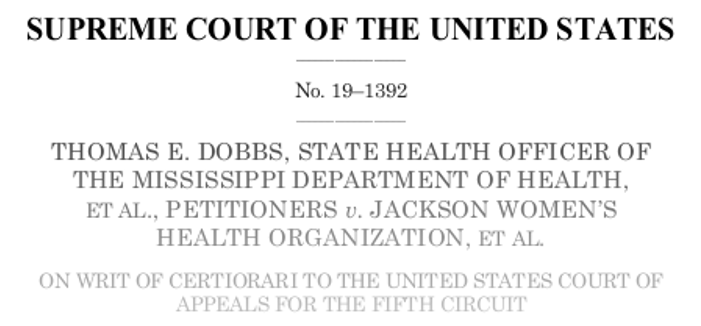
As always, you can find the Dobbs v. Jackson decision here.
Paragraph 4 of 8
Sentence 1 of 3
The next sentence seems to be making a purely logical point, but also cites another case as backup:
“Although a pre-quickening abortion was not itself considered homicide, it does not follow that abortion was permissible at common law—much less that abortion was a legal right. Cf. Glucksberg, 521 U.S., at 713 (removal of “common law’s harsh sanctions did not represent an acceptance of suicide”).
Here are three clauses that work as claims:
- “[A] pre-quickening abortion was not itself considered homicide.”
- “[I]t does not follow that abortion was permissible at common law.”
- “[I]t does not follow that [. . .] abortion was a legal right.”
This series of claims is true on its face. Many acts are in the category of “not homicide” and “not permissible” or “not a legal right.” Kidnapping isn’t homicide, and it’s neither permissible nor a legal right. Same with vandalism. Or carjacking. Or fraud. Or a million other things.
I don’t know that the point being made benefits from the cited support; the statement as a matter of logic is as acceptable without the citation as with it. I have to remind myself that the Dobbs authors aren’t trying to establish a strong argument regarding the justice of abortion—they’re establishing what has been the case in our history and tradition. So far none of the examples have established a strong argument, but many of the claims about history and tradition have been true, so the Court is making the case it’s trying to even though that line of discussion is less substantial than if they were to try to arrive at the correct answer (to whatever degree that’s possible).
The specific sentence cited in Glucksberg refers to a passage written by judge Zephaniah Swift, which reads:
“There can be no act more contemptible, than to attempt to punish an offender for a crime, by exercising a mean act of revenge upon lifeless clay, that is insensible of the punishment. There can be no greater cruelty, than the inflicting [of] a punishment, as the forfeiture of goods, which must fall solely on the innocent offspring of the offender …. [Suicide] is so abhorrent to the feelings of mankind, and that strong love of life which is implanted in the human heart, that it cannot be so frequently committed, as to become dangerous to society. There can of course be no necessity of any punishment.”
This is followed by the cited sentence, which reads as follows:
“This statement makes it clear, however, that the movement away from the common law’s harsh sanctions did not represent an acceptance of suicide; rather, as Chief Justice Swift observed, this change reflected the growing consensus that it was unfair to punish the suicide’s family for his wrongdoing.
I’m not sure how a discussion of the legal status of suicide illuminates how we should regard abortion, but there we have it. The thing is, this isn’t necessary. It’s obviously true that an act can be impermissible without being named “homicide,” and an act could be outside of consideration as a right without being named “homicide.” The discussion of suicide is interesting as an analogy, but argument by analogy doesn’t advance the argument in a meaningful way–
But the Court is trying to establish history and tradition, not reasoned argument, so it serves the purpose here. So even though the truth of these claims might not mean much—and might be a flashy distraction—these claims are indeed true.
- “[A] pre-quickening abortion was not itself considered homicide.”
- “[I]t does not follow that abortion was permissible at common law.”
- “[I]t does not follow that [. . .] abortion was a legal right.”
 Cynical Jason