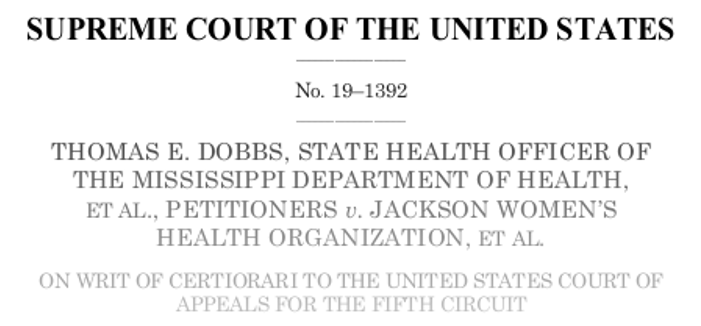
As always, you can find the Dobbs v. Jackson decision here.
Paragraph 8 of 9
Sentence 3 of 4
The next sentence is a strange one, and it contains two claims:
“’Substantive due process has at times been a treacherous field for this Court,’ Moore v. East Cleveland, 431 U. S. 494, 503 (1977) (plurality opinion), and it has sometimes led the Court to usurp authority that the Constitution entrusts to the people’s elected representatives. See Regents of Univ. of Mich. v. Ewing, 474 U. S. 214, 225–226 (1985).
Here are the claims:
- “Substantive due process has at times been a treacherous field for this Court.”
- “[Substantive due process] has sometimes led the Court to usurp authority that the Constitution entrusts to the people’s elected representatives.”
The use of the first claim is the strange part here. It’s just a quote from the Moore v. East Cleveland case with nothing added by the Dobbs Court. Normally a quote would be integrated somehow, with the current author’s thoughts controlling or determining the role of the cited material. In this case it’s just plopped in. The Dobbs Court presents the Moore claim without comment. Here’s the Moore quote in its original context (which starts on page 502, not 503):
“Substantive due process has at times been a treacherous field for this Court. There are risks when the judicial branch gives enhanced protection to certain substantive liberties without the guidance of the more specific provisions of the Bill of Rights. As the history of the Lochner era demonstrates, there is reason for concern lest the only limits to such judicial intervention become the predilections of those who happen at the time to be Members of this Court. [Footnote 9] That history counsels caution and restraint. But it does not counsel abandonment, nor does it require what the city urges here: cutting off any protection of family rights at the first convenient, if arbitrary boundary–the boundary of the nuclear family.
I’m neither a lawyer nor a legal historian, so “the Lochner era” doesn’t mean much to me. I have some reading to do on that, but it’s clear that the idea that “[s]ubstantive due process has at times been a treacherous field for this Court” is not a new idea—Moore was decided in 1977. Being an old idea doesn’t make it a true claim, though, so until I do that reading I’ll have to leave this one undetermined.
Then there’s the second claim:
“[Substantive due process] has sometimes led the Court to usurp authority that the Constitution entrusts to the people’s elected representatives.”
We’re pointed to Regents of the University of Michigan v. Ewing, and there is a passage there that makes the same claim:
“Considerations of profound importance counsel restrained judicial review of the substance of academic decisions. As JUSTICE WHITE has explained:
“Although the Court regularly proceeds on the assumption that the Due Process Clause has more than a procedural dimension, we must always bear in mind that the substantive content of the Clause is suggested neither by its language nor by preconstitutional history; that content is nothing more than the accumulated product of judicial interpretation of the Fifth and Fourteenth Amendments. This is . . . only to underline Mr. Justice Black’s constant reminder to his colleagues that the Court has no license to invalidate legislation which it thinks merely arbitrary or unreasonable. Moore v. East Cleveland, 431 U. S. 494, 431 U. S. 543-544 (1977) (WHITE, J., dissenting).”
See id. at 431 U. S. 502 (opinion of POWELL, J.). Added to our concern for lack of standards is a reluctance to trench on the prerogatives of state and local educational institutions and our responsibility to safeguard their academic freedom, “a special concern of the First Amendment.” Keyishian v. Board of Regents, 385 U. S. 589, 385 U. S. 603 (1967). [Footnote 12] If a “federal court is not the appropriate forum in which to review the multitude of personnel decisions that are made daily by public agencies,” Bishop v. Wood, 426 U. S. 341, 426 U. S. 349 (1976), far less is it suited to evaluate the substance of the multitude of academic decisions that are made daily by faculty members of public educational institutions — decisions that require
“an expert evaluation of cumulative information and [are] not readily adapted to the procedural tools of judicial or administrative decisionmaking.”
Board of Curators, Univ. of Mo. v. Horowitz, 435 U.S. at 435 U. S. 89-90.
I couldn’t find a PDF of the case online, so the link is to a Justia page with the transcript.
This is going to take more investigation to make any kind of determination about, so . . . it’s undetermined.
In this sentence we have two undetermined claims:
- “Substantive due process has at times been a treacherous field for this Court.”
- “[Substantive due process] has sometimes led the Court to usurp authority that the Constitution entrusts to the people’s elected representatives.”
 Cynical Jason