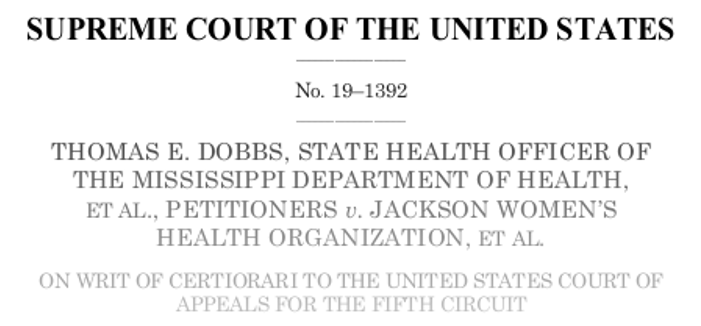
As always, you can find the Dobbs v. Jackson decision here.
Paragraph 6 of 9
Sentence 2 of 2
The next sentence contains three claims reiterating the point:
“Thus, in Glucksberg, which held that the Due Process Clause does not confer a right to assisted suicide, the Court surveyed more than 700 years of ‘Anglo-American common law tradition,’ 521 U. S., at 711, and made clear that a fundamental right must be “objectively, deeply rooted in this Nation’s history and tradition,” id., at 720–721.”
Here they are split up and stripped of citations:
- “Glucksberg [. . .] held that the Due Process Clause does not confer a right to assisted suicide.”
- “[I]n Glucksberg [. . .] the Court surveyed more than 700 years of ‘Anglo-American common law tradition.”
- “Glucksberg, [. . .] made clear that a fundamental right must be “objectively, deeply rooted in this Nation’s history and tradition.”
The first claim is easily confirmed:
“Glucksberg [. . .] held that the Due Process Clause does not confer a right to assisted suicide.”
Here are the opening lines of Washington v. Glucksberg:
“The question presented in this case is whether Washington’s prohibition against “caus[ing]” or “aid[ing]” a suicide offends the Fourteenth Amendment to the United States Constitution. We hold that it does not.”
There you have it in two sentences. The second claim is also an easy confirmation. The citation indicates page 711 of the Glucksberg decision:
“[I]n Glucksberg [. . .] the Court surveyed more than 700 years of ‘Anglo-American common law tradition.”
The citation is for page 711, but the recitation of historical context goes on for several pages. Here’s how it starts:
“More specifically, for over 700 years, the Anglo-American common-law tradition has punished or otherwise disapproved of both suicide and assisting suicide.9 Cruzan, 497 U. S., at 294-295 (SCALIA, J., concurring). In the 13th century, Henry de Bracton, one of the first legal-treatise writers, observed that ‘[j]ust as a man may commit felony by slaying another so may he do so by slaying himself’.”
Along the way, Glucksberg mentions Cruzan v. Missouri (among many decisions in U.S. legal history), Henri de Bracton, pre-Norman institutions, the Council of Hereford, King Edgar, Sir William Blackstone, the Stoic philosophers, the Providence Plantations, the Court at Common Bench, Sir Edward Coke, William Hawkins, Colonial Virginia, William Penn, Chief Justice Zephariah Swift, New York (and many other states), the Field Penal Code, the President’s Commission for the Study of Ethical Problems in Medicine and Biomedical and Behavioral Research, President Bill Clinton, and, finally, the decidedly not-in-our-history-or-traditions Canada, New Zealand, and Australia.
This is definitely a true claim. Exhaustively true.
The third claim, though, is a different matter:
“Glucksberg, [. . .] made clear that a fundamental right must be ‘objectively, deeply rooted in this Nation’s history and tradition’.”
The citation for this claim indicates Glucksberg pages 720 and 721, which is a short section (these are short pages), and nowhere in this section does the Court make the case that “a fundamental right must be ‘objectively, deeply rooted in this Nation’s history and tradition’.” The point is reiterated that this is common practice, but there isn’t even an attempt to establish that this practice is necessary. Here is the whole section, including the beginning of the paragraph at the end of page 719 and the first full paragraph on page 722:
“The Due Process Clause guarantees more than fair process, and the “liberty” it protects includes more than the absence of physical restraint. Collins v. Harker Heights, 503 U. S. 115, 125 (1992) (Due Process Clause “protects individual liberty against ‘certain government actions regardless of the fairness of the procedures used to implement them”’) (quoting Daniels v. Williams, 474 U. S. 327, 331 (1986)). The Clause also provides heightened protection against government interference with certain fundamental rights and liberty interests. Reno v. Flores, 507 U. S. 292, 301-302 (1993); Casey, 505 U. S., at 851. In a long line of cases, we have held that, in addition to the specific freedoms protected by the Bill of Rights, the “liberty” specially protected by the Due Process Clause includes the rights to marry, Loving v. Virginia, 388 U. S. 1 (1967); to have children, Skinner v. Oklahoma ex rel. Williamson, 316 U. S. 535 (1942); to direct the education and upbringing of one’s children, Meyer v. Nebraska, 262 U. S. 390 (1923); Pierce v. Society of Sisters, 268 U. S. 510 (1925); to marital privacy, Griswold v. Connecticut, 381 U. S. 479 (1965); to use contraception, ibid.; Eisenstadt v. Baird, 405 U. S. 438 (1972); to bodily integrity, Rochin v. California,342 U. S. 165 (1952), and to abortion, Casey, supra. We have also assumed, and strongly suggested, that the Due Process Clause protects the traditional right to refuse unwanted lifesaving medical treatment. Cruzan, 497 U. S., at 278-279.
“But we “ha[ve] always been reluctant to expand the concept of substantive due process because guideposts for responsible decisionmaking in this unchartered area are scarce and open-ended.” Collins, 503 U. S., at 125. By extending constitutional protection to an asserted right or liberty interest, we, to a great extent, place the matter outside the arena of public debate and legislative action. We must therefore “exercise the utmost care whenever we are asked to break new ground in this field,” ibid., lest the liberty protected by the Due Process Clause be subtly transformed into the policy preferences of the Members of this Court, Moore, 431 U. S., at 502 (plurality opinion).
“Our established method of substantive-due-process analysis has two primary features: First, we have regularly observed that the Due Process Clause specially protects those fundamental rights and liberties which are, objectively, “deeply rooted in this Nation’s history and tradition,” id., at 503 (plurality opinion); Snyder v. Massachusetts, 291 U. S. 97, 105 (1934) (“so rooted in the traditions and conscience of our people as to be ranked as fundamental”), and “implicit in the concept of ordered liberty,” such that “neither liberty nor justice would exist if they were sacrificed,” Palko v. Connecticut, 302 U. S. 319, 325, 326 (1937). Second, we have required in substantive-due-process cases a “careful description” of the asserted fundamental liberty interest. Flores, supra, at 302; Collins, supra, at 125; Cruzan, supra, at 277278. Our Nation’s history, legal traditions, and practices thus provide the crucial “guideposts for responsible decisionmaking,” Collins, supra, at 125, that direct and restrain our exposition of the Due Process Clause. As we stated recently in Flores, the Fourteenth Amendment “forbids the government to infringe … ‘fundamental’ liberty interests at all, no matter what process is provided, unless the infringement is narrowly tailored to serve a compelling state interest.” 507 U. S., at 302.
“JUSTICE SOUTER, relying on Justice Harlan’s dissenting opinion in Poe v. Ullman, 367 U. S. 497 (1961), would largely abandon this restrained methodology, and instead ask “whether [Washington’s] statute sets up one of those ‘arbitrary impositions’ or ‘purposeless restraints’ at odds with the Due Process Clause of the Fourteenth Amendment,” post, at 752 (quoting Poe, supra, at 543 (Harlan, J., dissenting)).
“In our view, however, the development of this Court’s substantive-due-process jurisprudence, described briefly supra, at 719-720, has been a process whereby the outlines of the “liberty” specially protected by the Fourteenth Amendment-never fully clarified, to be sure, and perhaps not capable of being fully clarified-have at least been carefully refined by concrete examples involving fundamental rights found to be deeply rooted in our legal tradition. This approach tends to rein in the subjective elements that are necessarily present in due process judicial review. In addition, by establishing a threshold requirement-that a challenged state action implicate a fundamental right-before requiring more than a reasonable relation to a legitimate state interest to justify the action, it avoids the need for complex balancing of competing interests in every case.
Through all of this, Glucksberg establishes that treating suicide as a crime has long been part of American law and English law before that, but what Glucksberg doesn’t establish—not in these two pages and not in this section beginning on page 711—is that it must be that way, and that’s the claim. I’m inclined to mark this as false, and I’ll tag it false, but in the interest of fairness and charity, I’ll leave it in the list of undetermined claims until I can look at it more closely.
So in the end, we have two true claims:
- “Glucksberg [. . .] held that the Due Process Clause does not confer a right to assisted suicide.”
- “[I]n Glucksberg [. . .] the Court surveyed more than 700 years of ‘Anglo-American common law tradition.”
and one false (but officially undetermined) claim:
- “Glucksberg, [. . .] made clear that a fundamental right must be “objectively, deeply rooted in this Nation’s history and tradition.”
 Cynical Jason