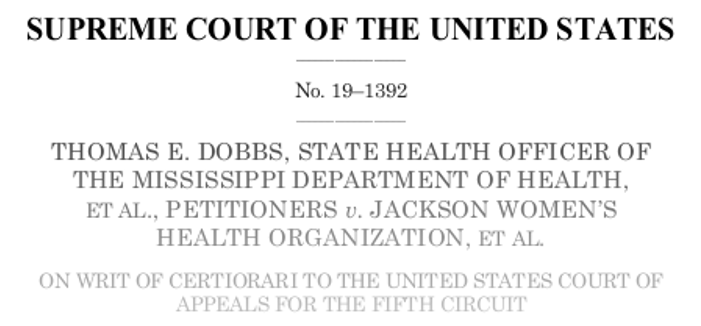
As always, you can find the Dobbs v. Jackson decision here.
Paragraph 3 of 9
Sentence 1 of 2
This first sentence in the third paragraph of this section comes with a boatload of citations:
“In deciding whether a right falls into either of these categories, the Court has long asked whether the right is “deeply rooted in [our] history and tradition” and whether it is essential to our Nation’s “scheme of ordered liberty.” Timbs v. Indiana, 586 U. S. ___, ___ (2019) (slip op., at 3) (internal quotation marks omitted); McDonald, 561 U. S., at 764, 767 (internal quotation marks omitted); Glucksberg, 521 U. S., at 721 (internal quotation marks omitted).
Let’s try that with just the text:
“In deciding whether a right falls into either of these categories, the Court has long asked whether the right is “deeply rooted in [our] history and tradition” and whether it is essential to our Nation’s “scheme of ordered liberty.”
Better. So this sentence contains one claim, which is that the court “has long asked” two questions when considering the legitimacy of rights. To confirm this as a true claim, we just need to establish that the Court has considered these questions for a long time, and the current Court gives us three cases, of which it looks like Glucksberg is the earliest in 1996. Here’s what Glucksberg has to say in the relevant passage, which actually begins on page 720:
“But we “ha[ve] always been reluctant to expand the concept of substantive due process because guideposts for responsible decisionmaking in this unchartered area are scarce and open-ended.” Collins, 503 U. S., at 125. By extending constitutional protection to an asserted right or liberty interest, we, to a great extent, place the matter outside the arena of public debate and legislative action. We must therefore “exercise the utmost care whenever we are asked to break new ground in this field,” ibid., lest the liberty protected by the Due Process Clause be subtly transformed into the policy preferences of the Members of this Court, Moore, 431 U. S., at 502 (plurality opinion).
“Our established method of substantive-due-process analysis has two primary features: First, we have regularly observed that the Due Process Clause specially protects those fundamental rights and liberties which are, objectively, “deeply rooted in this Nation’s history and tradition,” id., at 503 (plurality opinion); Snyder v. Massachusetts, 291 U. S. 97, 105 (1934) (“so rooted in the traditions and conscience of our people as to be ranked as fundamental”), and “implicit in the concept of ordered liberty,” such that “neither liberty nor justice would exist if they were sacrificed,” Palko v. Connecticut, 302 U. S. 319, 325, 326 (1937).
Glucksberg does specifically note those two concerns, and that’s good, since 1996 isn’t too distant in the past. The earliest citation in Glucksberg appears to be Snyder in 1934, which gives us 62 years more years of consideration. The first Supreme Court cases were in 1791, so if Snyder is the beginning of this line of thinking, it accounts for 88 of 231 years. Eighty-nine years is a long time for a person to live, but it’s less than half of the Supreme Court’s history. Let’s check out Snyder. Here’s the passage on page 105 of that decision:
“The Commonwealth of Massachusetts is free to regulate the procedure of its courts in accordance with its own conception of policy and fairness unless, in so doing, it offends some principle of justice so rooted in the traditions and conscience of our people as to be ranked as fundamental. Twining v. New Jersey, 211 U. S. 78, 211 U. S. 106, 211 U. S. 111, 211 U. S. 112; Rogers v. Peck, 199 U. S. 425, 199 U. S. 434; Maxwell v. Dow, 176 U. S. 581, 176 U. S. 604; Hurtado v. California, 110 U. S. 516; Frank v. Mangum, 237 U. S. 309, 237 U. S. 326; Powell v. Alabama, 287 U. S. 45, 287 U. S. 67.
EDIT 7/12/23: That doesn’t address the “ordered liberty” part of the Dobbs claim, and it cites six more cases. The next oldest case cited here is Palko in 1937. Here’s Palko at page 325 (in the paragraph that begins on page 324):
“In these and other situations, immunities that are valid as against the federal government by force of the specific pledges of particular amendments have been found to be implicit in the concept of ordered liberty, and thus, through the Fourteenth Amendment, become valid as against the states.”
The Court has been considering “ordered liberty” since at least 1937, and that’s 85 years at the time of Dobbs. Is that “long”? I don’t know. I’ll call this undetermined:
But here’s a modified version of the claim that is true:
“In deciding whether a right falls into either of these categories, the Court has [for at least 85 years] asked whether the right is “deeply rooted in [our] history and tradition” and whether it is essential to our Nation’s “scheme of ordered liberty.”
 Cynical Jason