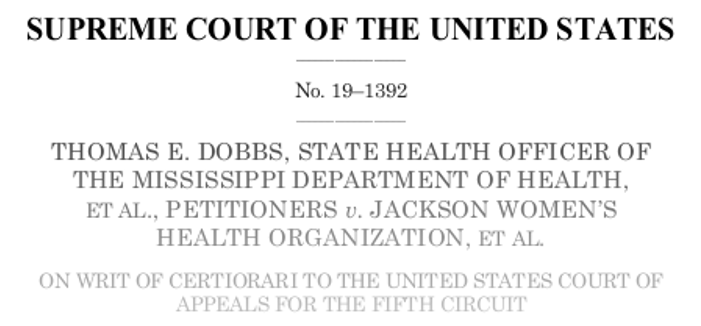
As always, you can find the Dobbs v. Jackson decision here.
Also, you can find the Roe v. Wade decision here.
Paragraph 3 of 5
Sentence 5 of 6
This sentence doesn’t add much to the argument, but it does add to the attitude. This part is where Alito and his clerks took a day off and Mrs. Johnson’s middle school debate team picked up the pen. The sentence:
“Roe expressed the “feel[ing]” that the Fourteenth Amendment was the provision that did the work, but its message seemed to be that the abortion right could be found somewhere in the Constitution and that specifying its exact location was not of paramount importance.”
This contains three claims:
- Roe expressed the “feel[ing]” that the Fourteenth Amendment was the provision that did the work,
- its message seemed to be that the abortion right could be found somewhere in the Constitution
- specifying its exact location was not of paramount importance.
So what’s going on with the first claim?
“Roe expressed the “feel[ing]” that the Fourteenth Amendment was the provision that did the work . . .”
I guess that’s one way to represent this:
“This right of privacy, whether it be founded in the Fourteenth Amendment’s concept of personal liberty and restrictions upon state action, as we feel it is, or, as the District Court determined, in the Ninth Amendment’s reservation of rights to the people, is broad enough to encompass a woman’s decision whether or not to terminate her pregnancy.”
All three of these claims refer to this same passage in Roe. Here’s the second one:
“. . . its message seemed to be that the abortion right could be found somewhere in the Constitution . . .”
Those are some serious weasel words, but the Roe Court does seem to be casting a wide net in all of the passages we’ve looked at for these last few sentences. This is the third quote:
“. . . specifying its exact location was not of paramount importance.”
This is just editorializing. All three of these reveal more snark than insight, but I’m going to call the first two true. I’m not sure about the third one (and not sure it’s worth the time to examine it), so I’ll leave it undetermined.
True:
Undetermined:
“[S]pecifying [the] exact location [of the right to privacy] was not of paramount importance.”
 Cynical Jason