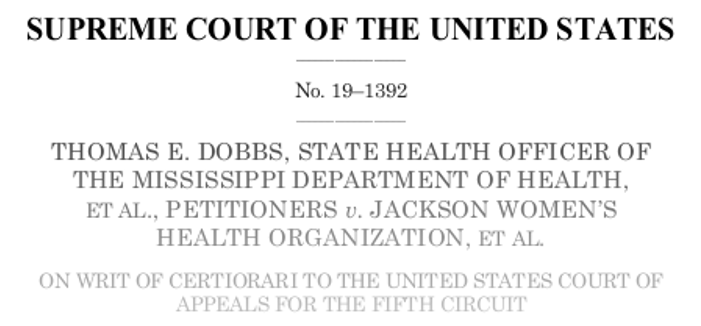
As always, you can find the Dobbs v. Jackson decision here.
Also, you can find the Roe v. Wade decision here.
Paragraph 2 of 5
Sentence 3 of 3
To finish out this paragraph we have a third sentence that sticks pretty closely to the previous one.
“And that privacy right, Roe observed, had been found to spring from no fewer than five different constitutional provisions—the First, Fourth, Fifth, Ninth, and Fourteenth Amendments.” Id., at 152.
Not only is this referring back to the previous sentence, it refers a second time to a paragraph that supported the claims in that sentence. I stripped out the citations and listed them at the end of the previous post, but here is the paragraph in question with the citations embedded:
“The Constitution does not explicitly mention any right of privacy. In a line of decisions, however, going back perhaps as far as Union Pacific R. Co. v. Botsford, 141 U. S. 250, 251 (1891), the Court has recognized that a right of personal privacy, or a guarantee of certain areas or zones of privacy, does exist under the Constitution. In varying contexts, the Court or individual Justices have, indeed, found at least the roots of that right in the First Amendment, Stanley v. Georgia, 394 U. S. 557, 564 (1969); in the Fourth and Fifth Amendments, Terry v. Ohio, 392 U. S. 1, 8-9 (1968), Katz v. United States, 389 U. S. 347, 350 (1967), Boyd v. United States, 116 U. S. 616 (1886), see Olmstead v. United States, 277 U. S. 438, 478 (1928) (Brandeis, J., dissenting); in the penumbras of the Bill of Rights, Griswold v. Connecticut, 381 U.S. at 484-485; in the Ninth Amendment, id. at 486 (Goldberg, J., concurring); or in the concept of liberty guaranteed by the first section of the Fourteenth Amendment, see Meyer v. Nebraska, 262 U. S. 390, 399 (1923).”
For simplicity’s sake, I’ll isolate the references to each amendment with its associated decision:
- in the First Amendment, Stanley v. Georgia, 394 U. S. 557, 564 (1969)
- in the Fourth and Fifth Amendments, Terry v. Ohio, 392 U. S. 1, 8-9 (1968), Katz v. United States, 389 U. S. 347, 350 (1967), Boyd v. United States, 116 U. S. 616 (1886), see Olmstead v. United States, 277 U. S. 438, 478 (1928) (Brandeis, J., dissenting)
- in the penumbras of the Bill of Rights
- Griswold v. Connecticut, 381 U.S. At 484-485
- in the Ninth Amendment, id. at 486 (Goldberg, J., concurring)
- or in the concept of liberty guaranteed by the first section of the Fourteenth Amendment, see Meyer v. Nebraska, 262 U. S. 390, 399 (1923)
Hell, Dobbs left out the reference to the “penumbras of the Bill of Rights.”
This sentence contains just a single claim, and it is true.
 Cynical Jason