As always, you can find the Dobbs v. Jackson decision here.
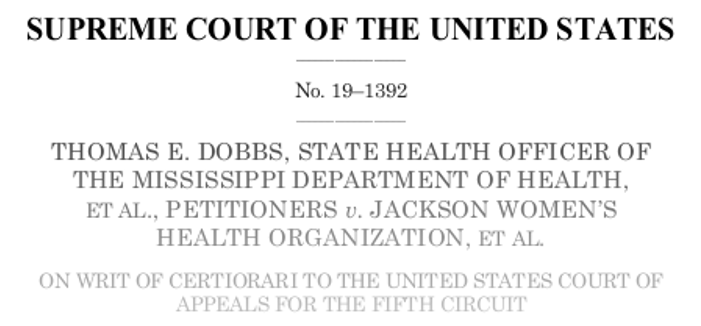
This is where I’m going to list all of the claims I’ve determined to be true as I go through Dobbs v. Jackson. Nothing is ever set in stone–if you think anything here is wrong, let me know. If your argument is good, if it’s well supported, I’ll change my mind and move the claim to a different list.
- “Constitutional analysis must begin with ‘the language of the instrument’.”
- “The Constitution makes no express reference to a right to obtain an abortion”
- “[T]hose who claim that [the Constitution] protects such a right must show that the right is somehow implicit in the constitutional text.”
- “[Roe] held that the abortion right . . . is part of a right to privacy.”
- “[A] right to privacy . . . is . . . not mentioned [in the Constitution].”
- “[T]hat privacy right, Roe observed, had been found to spring from no fewer than five different constitutional provisions—the First, Fourth, Fifth, Ninth, and Fourteenth Amendments.”
- “One possibility [Roe proposed] was that the right [to privacy] was ‘founded . . . in the Ninth Amendment’s reservation of rights to the people.’”
- “Another [possible origin Roe suggested to a right to abortion] was that the right was rooted in the First, Fourth, or Fifth Amendment, or in some combination of those provisions . . .”
- “. . . and that this right had been “incorporated” into the Due Process Clause of the Fourteenth Amendment . . .”cynicaljason.com/2023/04/17/dobbs-sentences-8-part-ii-a-1/https://cynicaljason.com/2023/04/17/dobbs-sentences-8-part-ii-a-1/
- “many other Bill of Rights provisions had by then been incorporated [into the Due Process Clause of the Fourteenth Amendment].”
- “And a third path was that the First, Fourth, and Fifth Amendments played no role and that the right was simply a component of the “liberty” protected by the Fourteenth Amendment’s Due Process Clause.”
- “Roe expressed the “feel[ing]” that the Fourteenth Amendment was the provision that did the work” of establishing a right to privacy.
- The Roe Court’s “message seemed to be that the abortion right could be found somewhere in the Constitution.”
- The Casey Court “grounded its decision solely on the theory that the right to obtain an abortion is part of the “liberty” protected by the Fourteenth Amendment’s Due Process Clause.”
- “[T]he Court has stated [that] the ‘goal of preventing abortion’ does not constitute ‘invidiously discriminatory animus’ against women.”
- We’ve addressed “this new theory.”
- “Those Amendments originally applied only to the Federal Government”
- “[T]his Court has held that the Due Process Clause of the Fourteenth Amendment ‘incorporates’ the great majority of those rights.”
- This incorporation “makes [the first eight Amendments] equally applicable to the States.”
- “The second category [. . .] is the one in question here.”
- “Justice Ginsburg’s opinion for the Court in Timbs is a recent example.”
- “In concluding that the Eighth Amendment’s protection against excessive fines is “fundamental to our scheme of ordered liberty” and “deeply rooted in this Nation’s history and tradition,” [. . .], her opinion traced the right back to Magna Carta, Blackstone’s Commentaries, and 35 of the 37 state constitutions in effect at the ratification of the Fourteenth Amendment.
- “The lead opinion [in McDonald] surveyed the origins of the Second Amendment, the debates in Congress about the adoption of the Fourteenth Amendment, the state constitutions in effect when that Amendment was ratified (at least 22 of the 37 States protected the right to keep and bear arms), federal laws enacted during the same period, and other relevant historical evidence.
- “Only then did the opinion conclude that ‘the Framers and ratifiers of the Fourteenth Amendment counted the right to keep and bear arms among those fundamental rights necessary to our system of ordered liberty.’”
- “Timbs and McDonald concerned the question whether the Fourteenth Amendment protects rights that are expressly set out in the Bill of Rights.”
- “Glucksberg [. . .] held that the Due Process Clause does not confer a right to assisted suicide.”
- “[I]n Glucksberg [. . .] the Court surveyed more than 700 years of ‘Anglo-American common law tradition.”
- “Lincoln once said: ‘We all declare for Liberty; but in using the same word we do not all mean the same thing.’”
- “As Lincoln once said: ‘We all declare for Liberty; but in using the same word we do not all mean the same thing.’”
- “In a well-known essay, Isaiah Berlin reported that ‘[h]istorians of ideas’ had cataloged more than 200 different senses in which the term had been used.”
- “In interpreting what is meant by the Fourteenth Amendment’s reference to ‘liberty,’ we must guard against the natural human tendency to confuse what that Amendment protects with our own ardent views about the liberty that Americans should enjoy.”
- “That is why the Court has long been ‘reluctant’ to recognize rights that are not mentioned in the Constitution.”
- “[T]he Court cautioned in Glucksberg [that] ‘[w]e must . . . exercise the utmost care whenever we are asked to break new ground in this field, lest the liberty protected by the Due Process Clause be subtly transformed into the policy preferences of the Members of this Court.’”
- “We begin with the common law.”
- “In 1732, for example, Eleanor Beare was convicted of ‘destroying the Foetus in the Womb’ of another woman and ‘thereby causing her to miscarry.’”
- “For that crime and another ‘misdemeanor,’ Beare was sentenced to two days in the pillory and three years’ imprisonment.
- “[A] pre-quickening abortion was not itself considered homicide.”
- “[I]t does not follow that abortion was permissible at common law.”
- “[I]t does not follow that [. . .] abortion was a legal right.”
- “[I]n the 1732 case [of Eleanor Beare], the judge said of the charge of abortion (with no mention of quickening) that he had ‘never met with a case so barbarous and unnatural.’28”
- “As Blackstone explained, to be ‘murder’ a killing had to be done with ‘malice aforethought, . . . either express or implied.’”
- “In the case of an abortionist, Blackstone wrote, ‘the law will imply [malice]’ for the same reason that it would imply malice if a person who intended to kill one person accidentally killed a different person: ‘[I]f one shoots at A and misses him, but kills B, this is murder; because of the previous felonious intent, which the law transfers from one to the other. The same is the case, where one lays poison for A; and B, against whom the prisoner had no malicious intent, takes it, and it kills him; this is likewise murder. So also, if one gives a woman with child a medicine to procure abortion, and it operates so violently as to kill the woman, this is murder in the person who gave it.’ Id., at 200–201 (emphasis added; footnote omitted).29
- “In Maryland in 1652, for example, an indictment charged that a man ‘Murtherously endeavoured to destroy or Murther the Child by him begotten in the Womb.’”
- “In 1803, the British Parliament made abortion a crime at all stages of pregnancy and authorized the imposition of severe punishment.”
- “Roe discerned a ‘trend toward liberalization’ in about ‘one-third of the States’.”
- “[G]reat common-law authorities like Bracton, Coke, Hale, and Blackstone all wrote that a post-quickening abortion was a crime.”
- “[W]e have seen [that] great common-law authorities like Bracton, Coke, Hale, and Blackstone all wrote that a post-quickening abortion was a crime.”
- “[T]he insistence on quickening was not universal.”
- “[T]he fact that many States in the late 18th and early 19th century did not criminalize pre-quickening abortions does not mean that anyone thought the States lacked the authority to do so.”
- “[C]ommon-law authorities had repeatedly condemned abortion and described it as an ‘unlawful’ act without regard to whether it occurred before or after quickening.”
- “This Court has long disfavored arguments based on alleged legislative motives.”
- “Even when an argument about legislative motive is backed by statements made by legislators who voted for a law, we have been reluctant to attribute those motives to the legislative body as a whole.”
- “One may disagree with this belief.”
- “Roe termed this [broader entrenched right] a right to privacy.”
- “Casey described [the broader entrenched right] as the freedom to make ‘intimate and personal choices’ that are ‘central to personal dignity and autonomy.’”
- “Casey elaborated: ‘At the heart of liberty is the right to define one’s own concept of existence, of meaning, of the universe, and of the mystery of human life.’”
- “The Court did not claim that this broadly framed right is absolute.”
- “[I]ndividuals are certainly free to think and to say what they wish about ‘existence,’ ‘meaning,’ the ‘universe,’ and ‘the mystery of human life’.”
- “License to act on the basis of such beliefs may correspond to one of the many understandings of ‘liberty.’”
- “Roe and Casey each struck a particular balance between the interests of a woman who wants an abortion and the interests of what they termed ‘potential life’.”
- “[T]he people of the various States may evaluate [“the interests of a woman who wants an abortion and the interests of what they termed ‘potential life’”] differently.”
- “In some States, voters may believe that the abortion right should be even more extensive than the right that Roe and Casey recognized.”
- “Voters in other States may wish to impose tight restrictions based on their belief that abortion destroys an ‘unborn human being.’”
- “What sharply distinguishes the abortion right from the rights recognized in the cases on which Roe and Casey rely is something that both those decisions acknowledged: Abortion destroys what those decisions call ‘potential life’ and what the law at issue in this case regards as the life of an ‘unborn human being.’”
- “[B]oth [of] those decisions acknowledged [that a]bortion destroys what those decisions call ‘potential life’ and what the law at issue in this case regards as the life of an ‘unborn human being.’”
- “Abortion destroys what those decisions call ‘potential life’ and what the law at issue in this case regards as the life of an ‘unborn human being.’”
- “None of the other decisions cited by Roe and Casey involved the critical moral question posed by abortion.”
- “[W]e accept for the sake of argument [Casey’s claim] that ‘the specific practices of States at the time of the adoption of the Fourteenth Amendment’ do not ‘mar[k] the outer limits of the substantive sphere of liberty which the Fourteenth Amendment protects.’”
- “Casey’s claim [is] that ‘the specific practices of States at the time of the adoption of the Fourteenth Amendment’ do not ‘mar[k] the outer limits of the substantive sphere of liberty which the Fourteenth Amendment protects.’”
- “Abortion is nothing new.”
- “[Abortion] has been addressed by lawmakers for centuries.”
- “[T]he fundamental moral question that [abortion] poses is ageless.”
- “[Americans who believe that abortion should be restricted note] that federal and state laws ban discrimination on the basis of pregnancy.”
- “[Americans who believe that abortion should be restricted note] that leave for pregnancy and childbirth are now guaranteed by law in many cases.”
- “[Americans who believe that abortion should be restricted note] that the costs of medical care associated with pregnancy are covered by insurance or government assistance.”
- “[Americans who believe that abortion should be restricted note] that States have increasingly adopted “safe haven” laws, which generally allow women to drop off babies anonymously.”
- “[Americans who believe that abortion should be restricted note] that a woman who puts her newborn up for adoption today has little reason to fear that the baby will not find a suitable home.”
- “[S]upporters of Roe and Casey must show that this Court has the authority to weigh those arguments and decide how abortion may be regulated in the States.”
- “[W]e thus return the power to weigh those arguments to the people and their elected representatives.”
- “The dissent is very candid that it cannot show that a constitutional right to abortion has any foundation, let alone a ‘“deeply rooted”’ one, ‘“in this Nation’s history and tradition.”’”
- “[T]he dissent[] professe[s] fidelity to stare decisis.”
- “[O]ur review of this Nation’s tradition extends well past that period.”
- “[T]he dissent claims that its standard ‘does not mean anything goes,’”
- “[A]ll of the precedents Roe cited, including Griswold and Eisenstadt, were critically different for a reason that we have explained: None of those cases involved the destruction of what Roe called “potential life.”
- “Under the doctrine of stare decisis, those precedents are entitled to careful and respectful consideration.”
- “[T]he Court has reiterated time and time again [that] adherence to precedent is not ‘“an inexorable command.”’
- “The exercise of the rights at issue in Griswold, Eisenstadt, Lawrence, and Obergefell does not destroy a ‘potential life.’”
- “[A]n abortion has that effect [destroy[s] a ‘potential life’].”
- “[T]he effects of pregnancy on women, the burdens of motherhood, and the difficulties faced by poor women” “are important concerns.”
- “The dissent repeatedly praises the ‘balance’ [. . .] that the viability line strikes between a woman’s liberty interest and the State’s interest in prenatal life.”
- “[T]o live” is “the most basic human right.”
 Cynical Jason