One thing to note about the Dobbs decision (view or download here) is that it is an essay. It follows the same structure as the essays commonly taught in high schools and colleges all over the United States and around the world.
The decision is divided into eight parts, the first with no heading or title, and the other seven indicated by the Roman numerals I through VII.
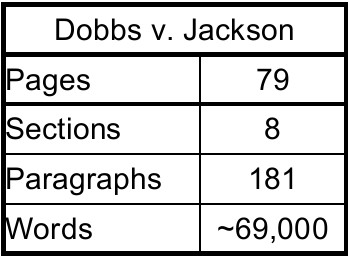
The first part is the introduction (which I’ve also seen called an “Introductory Statement”), and it’s twelve paragraphs long. This presents general information that explains why the Court has determined that they need to overturn both Roe v Wade and Planned Parenthood v Casey.
“Wait,” you might say. “I thought this case was about a law in Mississippi.” You would be correct. This seems like two related but separate topics. The next part of the decision explains that a little better.
Part I (the second part) is only four paragraphs long. This explains the Mississippi Gestational Age Act, the legal proceedings that led to the Dobbs case reaching the SC, and what exactly the court has agreed to do.
Part II is 66 paragraphs long, and is divided into five subsections. The first of these has no heading or title, and the other four are indicated by the letters A through D. This part considers the constitutional and historical justifications for a right to abortion leading up to Roe v. Wade.
Part III is 64 paragraphs long, and is divided into six subsections. The first of these has no heading or title, and the other five are indicated by the letters A through E. This considers the idea of stare decisis and its implications, specifically as they apply to Roe and Casey.
Part IV is only eight paragraphs long. This considers a final concern from Casey (read to get a better handle on this)
Part V is twenty paragraphs long, and is divided into two subsections, designated A and B. This part briefly addresses the dissent and Chief Justice Roberts’s partial concurrence.
Part VI is five paragraphs long, and is divided into three subsections: an untitled first section, section A, and section B. This considers how future decisions might deal with the issue of abortion.
The eighth and final part, part VII, is only two paragraphs long. This is a conclusion.
 Cynical Jason